











Table of Contents
Toggle


QUICK ANSWER
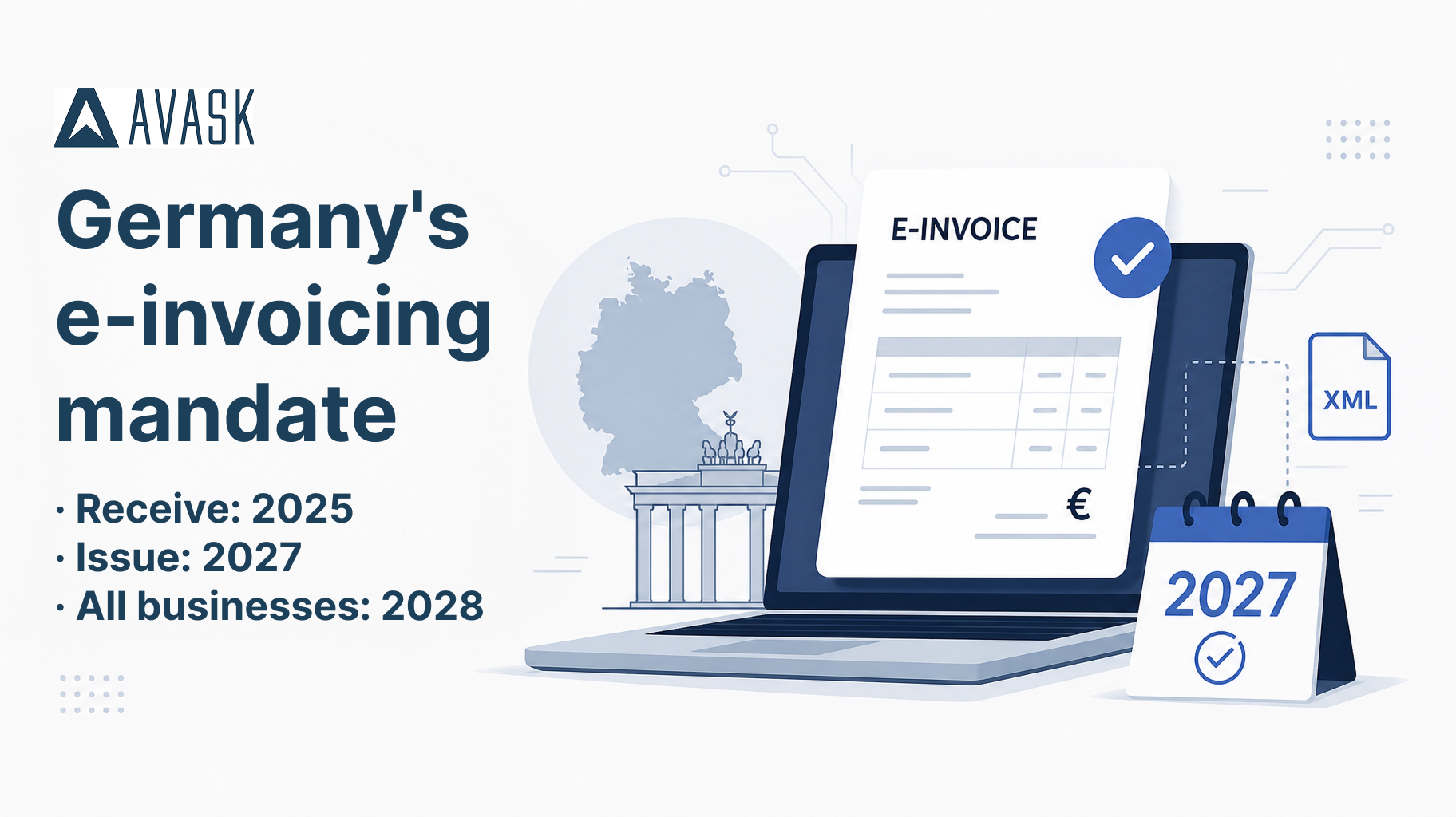
Germany’s e-invoicing mandate applies to B2B invoices between businesses established in Germany. Since 1 January 2025, every such business must be able to receive structured e-invoices in a format that meets the European standard EN 16931, such as XRechnung or ZUGFeRD. From 1 January 2027, businesses with prior-year turnover above €800,000 must also issue them; from 1 January 2028, all businesses must. A foreign business that is only VAT-registered in Germany, with no fixed establishment there, falls outside the obligation to issue e-invoices. There has been no postponement.
| STATUS AS OF SEPTEMBER 2026Receiving obligation in force since 1 January 2025. Issuing obligation starts on 1 January 2027 for businesses with prior-year turnover above €800,000, and on 1 January 2028 for all others. No postponement has been adopted, although a major trade body formally requested one in June 2026. On 16 July 2026 the federal government announced plans for a real-time VAT reporting system; no start date has been set.Last updated: 15 September 2026 |
From 1 January 2027, the ordinary PDF invoice stops being good enough for a large part of German business. Companies with prior-year turnover above €800,000 must send domestic B2B invoices as structured e-invoices, and a year later the rule reaches everyone else. The obligation to receive e-invoices has applied since January 2025.
E-invoicing in Germany is settled law, not a proposal. The Growth Opportunities Act rewrote the invoicing rules in the German VAT Act, the Federal Ministry of Finance has published two detailed guidance letters, and despite pressure from parts of the business community, the dates have not moved.
Most published guidance on the German mandate is written for finance teams inside German companies with an ERP system to reconfigure. Cross-border sellers need a different question answered first: does this apply to me at all? If you hold a German VAT number because your stock sits in German fulfilment centres, but you have no company, office or staff in Germany, the answer is more favourable than most vendor guides suggest — and still not a reason to ignore it.
This guide covers what the mandate requires, who is genuinely in scope, and what to do before January. If the underlying concept is new to you, start with how e-invoicing works and what businesses actually gain from e-invoicing.
Table of Contents
ToggleWhat Germany’s e-invoicing mandate requires — and when
Germany’s B2B e-invoicing mandate comes from the Growth Opportunities Act (Wachstumschancengesetz), passed in March 2024. It rewrote the invoicing rules in section 14 of the German VAT Act (Umsatzsteuergesetz, or UStG) for supplies made from 1 January 2025. The Federal Ministry of Finance (BMF) sets out how the rules apply in guidance letters of 15 October 2024 and 15 October 2025, and in its official e-invoicing FAQ.
The central change is a new definition. An e-invoice (E-Rechnung) is now only an invoice that is issued, transmitted and received in a structured electronic format that allows electronic processing. A PDF sent by email used to count as an electronic invoice; it no longer does. Paper invoices and unstructured electronic files are now classed as ‘other invoices’ (sonstige Rechnungen), and for domestic B2B transactions they are only permitted while the transition rules last.
The mandate also separates two obligations that are easy to conflate: receiving e-invoices, which already applies, and issuing them, which is being phased in.
GERMANY E-INVOICING TIMELINE
| Date | What applies | Who it affects |
|---|---|---|
| 1 January 2025 | All domestic businesses must be able to receive e-invoices. Paper invoices — and PDFs, with the recipient’s agreement — may still be issued. | Every business established in Germany |
| 1 January 2027 | E-invoices required for domestic B2B invoices. EDI procedures that do not meet the e-invoice definition may still be used until the end of 2027. | Businesses with prior-year turnover above €800,000 |
| 1 January 2028 | E-invoices required for all domestic B2B invoices, subject to the exemptions below. | All remaining businesses |
| 1 July 2030 | EU-wide e-invoicing and digital reporting for intra-EU B2B transactions under ViDA. | Businesses making B2B supplies within the EU |
While other invoices remain permitted during the transition, they still count as proper invoices for input VAT purposes. A paper invoice can always be used in that period, but an unstructured electronic invoice such as a PDF still needs the recipient’s agreement.
The €800,000 threshold explained
The extra year of transition depends on the supplier’s turnover in the previous calendar year. If your turnover in 2026 was €800,000 or less, you may continue to issue other invoices throughout 2027. If it was higher, the domestic B2B invoices you issue from 1 January 2027 must be e-invoices unless an exemption applies. Group structures, acquisitions and newly formed German entities can change how this works in practice, so it is worth confirming rather than assuming.
Does the German e-invoicing mandate apply to you?
The mandate applies to domestic B2B transactions between domestic businesses. Under the BMF’s guidance, a business is domestic if it has its registered office, its place of management, or a fixed establishment involved in the transaction in Germany. Where there is no registered office, the owner’s residence or habitual abode decides.
That single definition does most of the work. Four situations cover almost every cross-border seller.
| Your situation | Must you issue German e-invoices? | What else to know |
|---|---|---|
| A. Established in Germany (German company, branch or fixed establishment) | Yes — from 2027 or 2028, depending on prior-year turnover | You must already be able to receive e-invoices |
| B. VAT-registered in Germany, not established there | No — the issuing obligation does not apply | You can say so on your invoices; expect to receive e-invoices from German suppliers |
| C. Selling to consumers | No — B2C sales are outside the mandate | OSS, IOSS and DAC7 obligations are unaffected |
| D. Invoicing German public bodies | Yes — under separate public-sector rules | These rules often apply wherever you are established |
Scenario A — You are established in Germany
If you have a German GmbH, a German branch, or a fixed establishment in Germany that is involved in the supply — broadly, a permanent presence with its own people and technical resources — the full mandate applies. You must already be able to receive e-invoices, and your issuing date depends on your prior-year turnover.
That includes German subsidiaries of US and UK groups. Group structures change the answer: one entity established in Germany is in scope even if the parent company is not.
Scenario B — You are VAT-registered in Germany but not established there
This describes most of the e-commerce businesses we work with: a US or UK seller registered for German VAT because it holds stock in Amazon fulfilment centres or with a third-party logistics provider, with no German company and no staff or office in the country.
A German VAT registration on its own does not make a business domestic. The BMF’s FAQ confirms that foreign businesses registered for VAT in Germany without a fixed establishment there can state this on their invoices to explain why they are not issuing an e-invoice, and that customers may rely on that statement if they exercise normal commercial care.
Establishment is a technical VAT test, though, not a commercial label. Holding stock in a German warehouse, using Amazon FBA or Pan-European FBA, or working with a German fulfilment provider does not automatically make you established. A German office, German employees or a warehouse run by your own people can change the answer, so it is worth confirming formally — everything else follows from it.
Being outside the issuing obligation does not mean e-invoicing passes you by:
- Your customers are in scope. German business customers must be able to receive e-invoices, and as their systems move to structured data, many will ask suppliers to send them — whatever the law requires of you.
- Your suppliers will send them. German suppliers, logistics providers and agencies increasingly issue XRechnung or ZUGFeRD files. You need to be able to read, process and store them.
- Reporting is coming. Germany has announced a real-time VAT reporting system, and EU-wide digital reporting for cross-border B2B transactions begins in July 2030.
Your e-invoicing position also sits inside your wider German tax position. Our guide to VAT in Germany covers registration and filing for non-resident sellers.
| Not sure whether you have a fixed establishment in Germany?Establishment status decides whether Germany’s e-invoicing mandate applies to you, and it is rarely as obvious as it looks. Our specialists map your entities, VAT registrations and stock locations against the rules and tell you exactly which obligations apply, and when. Book an e-invoicing readiness review → |
Scenario C — You sell to consumers or through marketplaces
Sales to private consumers are outside the mandate. The rules only apply where German VAT law requires an invoice to another business, so if you sell to German consumers through Amazon, your own website or another marketplace, nothing changes in how you invoice them.
Two related obligations are often confused with e-invoicing. If you declare cross-border consumer sales through the One Stop Shop or Import One Stop Shop, those returns continue as before. Marketplace reporting under DAC7 is a separate obligation again. The German mandate replaces neither. Business customers buying through a marketplace remain business customers, though: if you are established in Germany, your invoices to them are in scope.
Scenario D — You invoice German public bodies
Invoices to public authorities follow their own rules. Suppliers to federal bodies have had to send e-invoices since 27 November 2020 under the federal E-Invoicing Ordinance (E-Rechnungsverordnung, or ERechV) for invoices from €1,000, using the federal submission platform OZG-RE. The federal states set their own requirements.
Public-sector invoices need a Leitweg-ID, a routing identifier supplied by the authority; ordinary B2B e-invoices do not. These rules sit alongside the VAT rules rather than replacing them, and they frequently apply wherever the supplier is established. The federal government’s E-Rechnung Bund portal explains the process in English.
What counts as an e-invoice in Germany: XRechnung, ZUGFeRD and EDI
The legal test is structure, not appearance. An e-invoice must use a structured electronic format that meets the European standard EN 16931, so its content can be processed automatically without anyone re-keying it. Germany does not prescribe a single format. In practice, there are three routes:
- XRechnung — a pure XML format and Germany’s national implementation of EN 16931, maintained by the Coordination Office for IT Standards (KoSIT). It is the standard for public-sector invoices and fully valid for B2B. It has no built-in human-readable page, so you need software or a viewer to read it.
- ZUGFeRD — a hybrid format that embeds XML inside a PDF/A-3 file, maintained by the German e-invoicing forum FeRD. It looks like a normal PDF but carries machine-readable data. Versions from 2.0.1 qualify, except the MINIMUM and BASIC-WL profiles. It is technically identical to Factur-X, the format most French businesses will use.
- EDI and other agreed formats — suppliers and customers can agree another structured format, such as EDIFACT, provided all the required invoice details can be extracted correctly and completely. EDI procedures that do not meet that test can only be used until the end of 2027.
Two rules catch businesses out. First, in a hybrid ZUGFeRD invoice the structured XML now takes precedence: if the XML and the visible PDF disagree, the XML counts. Second, every mandatory VAT detail must sit in the structured data itself. An attachment can add supporting information, such as a breakdown of hours, but it cannot replace a required field.
E-invoicing changes the format of a German VAT invoice, not its mandatory content. For a refresher on the principles, see what a compliant VAT invoice must contain.
How e-invoices are sent and received in Germany
Unlike Italy or Poland, Germany has no central government platform that clears B2B invoices before they become valid. It uses a post-audit model: invoices travel directly between businesses, and the tax authority examines them later, typically during an audit.
The law does not prescribe a transmission channel. Email, a direct system interface, a download from a customer portal, shared storage within a group, and interoperability networks such as Peppol are all acceptable. To meet the receiving obligation, an email inbox is enough.
That flexibility is convenient, but it makes exchange uneven at scale, and more businesses are turning to Peppol to send and receive structured invoices reliably. If your customers are heading that way, our guide on how to get a Peppol ID explains the first step. If you simply need to read an XRechnung file you have received, the German tax administration offers a free e-invoice viewer through ELSTER.
Exemptions: when you don’t need to issue an e-invoice
The mandate only applies where German VAT law requires an invoice in the first place. It therefore does not cover invoices to consumers or many VAT-exempt supplies, such as exempt financial services and residential lettings.
Even where an invoice is required, it does not have to be an e-invoice for:
- small-amount invoices of up to €250 including VAT;
- tickets that serve as invoices, such as travel tickets;
- supplies made by small businesses under the Kleinunternehmer scheme — although they must still be able to receive e-invoices;
- supplies to legal entities that are not businesses, such as many associations (public-sector rules may still apply to public bodies);
- certain property-related supplies to private individuals.
In these cases, a paper or PDF invoice remains acceptable.
Errors, input VAT and archiving
The BMF’s second letter, published on 15 October 2025, sets out what happens when an e-invoice is wrong. It distinguishes between format errors, where the file does not meet a structured format at all and so is not an e-invoice, and errors in business rules or content, such as a missing mandatory field. Where those errors affect VAT-relevant details, the invoice generally does not entitle the customer to deduct input VAT, and the customer is advised to reject it and request a correction. Corrections must themselves be issued as e-invoices.
That shifts where the risk sits. A PDF that looks perfect is no longer the test; the data underneath it is. Validating invoices against the format and business rules is not a legal precondition, but the BMF recommends it, and for any business processing volume it is the only practical way to catch errors before they repeat across thousands of invoices.
Invoices must be kept for eight years under German VAT law. For an e-invoice, at least the structured part must be preserved unaltered in its original form, so keeping only a PDF image of an XRechnung file is not enough. The federal government’s July 2026 action plan against tax crime proposes extending the retention period for accounting records to 15 years. That is a policy objective, not yet law.
| The risk now sits in your invoice dataStructured invoices fail on missing or inconsistent data far more often than on format, and errors repeat quietly across returns. The AVASK compliance platform brings invoice data, VAT reporting and reconciliation into one environment, so differences surface before they reach a tax authority. See the AVASK platform → |
Germany e-invoicing news: what has changed and what’s next
Germany’s timetable has held, but the picture around it keeps moving. The key developments, most recent first:
- 16 July 2026 — Real-time VAT reporting announced. The federal finance and justice ministries published an action plan against tax and financial crime that includes a VAT reporting system and a proposal to extend record retention to 15 years. It sets political objectives rather than draft legislation, and no start date has been given.
- 22–24 June 2026 — Rollout confirmed on track. At the German e-invoicing summit in Berlin, industry and policy representatives reported that the 1 January 2027 issuing date stands.
- 22 June 2026 — Postponement requested. The German Confederation of Skilled Crafts (ZDH) asked for the 2027 issuing date for businesses above €800,000 to move to 1 January 2028, citing unresolved questions about how VAT fields map to the e-invoice standard. The request has not been adopted.
- March 2026 — Official FAQ updated. The BMF refreshed its e-invoicing FAQ.
- 15 October 2025 — Second BMF letter. Clarified error handling, validation, corrections and archiving.
- 1 January 2025 — Mandate in force. The receiving obligation began for all domestic businesses.
Has Germany delayed the e-invoicing mandate?
No. As of September 2026, no postponement has been adopted, and the BMF’s guidance still sets out the 2027 and 2028 dates. A trade body has formally asked for a one-year delay, and autumn tax legislation can move quickly, so we will update this page if the position changes. Planning around any date other than 1 January 2027 would be a gamble.
What comes after e-invoicing
The e-invoice is the groundwork for reporting. The BMF has said from the outset that a transaction-based reporting system will follow, and that system depends on invoice data already flowing in structured form. At EU level, VAT in the Digital Age (ViDA) makes e-invoicing and near real-time digital reporting mandatory for intra-EU B2B transactions from 1 July 2030. Unlike Germany’s domestic mandate, that reporting is not conditional on being established in the country — see how ViDA affects non-EU sellers.
How Germany compares with France and Poland
Germany is one of several EU countries moving at once, and the establishment logic is broadly similar. France’s e-invoicing mandate went live on 1 September 2026 with an accredited-platform model and a separate e-reporting obligation that can reach VAT-registered sellers. Poland’s KSeF mandate is a clearance system that follows a registered office or fixed establishment in Poland. Germany is the lightest-touch of the three: no government platform, no clearance and, for now, no reporting obligation. For the wider picture, see which countries have mandatory e-invoicing.
What to do now
If you are established in Germany
- Check your 2026 turnover against the €800,000 threshold to confirm your issuing date.
- Make sure your invoicing or ERP system can produce XRechnung or ZUGFeRD (version 2.0.1 or later) with every mandatory VAT detail in the structured data.
- Set up a process to capture, validate and archive incoming e-invoices in their original format.
- Agree formats and channels with your largest customers and suppliers now — commercial deadlines often land before legal ones.
- Review any EDI connections that will need to meet the extraction test by 2028.
If you are VAT-registered in Germany but not established
- Confirm your establishment status formally, particularly if you have German staff, an office or a warehouse you operate yourself.
- Add a note to invoices for German business customers explaining that you have no fixed establishment in Germany, using wording agreed with your adviser.
- Make sure you can read and archive the structured invoices you receive from German suppliers.
- Ask your key German B2B customers what they will require from 2027.
- Review your wider German position at the same time: VAT registration and filing, EPR obligations and customs treatment often change together.
| January 2027 is closer than it looksMapping obligations, fixing invoice data and agreeing formats with customers is a project, not an afternoon. AVASK manages VAT registration, filing and e-invoicing readiness for online sellers expanding into Europe, with 420+ specialists across 12 countries. Get e-invoicing ready with AVASK → |
Frequently asked questions
What do I need to do now?
It depends on whether your business is established in Germany and what you sell. Businesses established in Germany must already be able to receive e-invoices and, if their prior-year turnover exceeds €800,000, issue them from 1 January 2027. Foreign sellers that are only VAT-registered in Germany should confirm their establishment status and prepare to exchange structured invoices with German customers and suppliers.
I’m an AVASK client — how can AVASK help?
We can confirm how the German rules apply to your business, explain what needs to change and when, and support you with the relevant e-invoicing and VAT compliance services.
I’m not an AVASK client — how can AVASK help?
AVASK can assess how Germany’s e-invoicing requirements apply to your business and, where action is needed, support you with the right solution. Talk to an AVASK expert.
Is e-invoicing mandatory in Germany?
Yes, for domestic B2B transactions between businesses established in Germany. All such businesses have had to be able to receive e-invoices since 1 January 2025. Issuing becomes mandatory from 1 January 2027 for businesses with prior-year turnover above €800,000, and from 1 January 2028 for all others.
Does the German mandate apply to foreign companies with a German VAT number?
Not the obligation to issue e-invoices, if the company has no fixed establishment in Germany. According to the BMF, such businesses can state on their invoices that they are not established in Germany. A German entity, German staff or a self-operated site can change that.
What is the format of an e-invoice in Germany?
A structured electronic format that meets the European standard EN 16931. XRechnung and ZUGFeRD from version 2.0.1 (except the MINIMUM and BASIC-WL profiles) both qualify. Other structured formats, such as EDI, can be agreed between the parties if all required invoice details can be extracted.
Is a PDF invoice still valid in Germany?
A plain PDF is not an e-invoice. During the transition it can still be used as an ‘other invoice’ with the recipient’s agreement — until the end of 2026 for most businesses, and until the end of 2027 for those with prior-year turnover of €800,000 or less. Invoices to consumers can remain PDFs.
Has Germany delayed the e-invoicing mandate?
No postponement has been adopted. A trade body asked in June 2026 for the 2027 date to move to 2028, but the official dates remain 1 January 2027 and 1 January 2028.
Do I need a Leitweg-ID?
Only for invoices to German public bodies. B2B e-invoices do not need one.
How long do e-invoices have to be kept in Germany?
Eight years under German VAT law, with at least the structured data kept unaltered in its original format. A July 2026 government action plan proposes extending retention for accounting records to 15 years, but that has not been legislated.
Which countries have mandatory e-invoicing?
More than 30 countries now require it, including Italy, Poland, Belgium and France, with Germany phasing in its B2B mandate. Our country-by-country e-invoicing guide covers each regime.
What is e-invoicing in Europe?
It is the exchange of invoices in a structured format that systems can process automatically. EU countries are introducing national mandates at different speeds, and from July 2030 ViDA makes e-invoicing mandatory for intra-EU B2B transactions. Our e-invoicing compliance overview explains what applies where.
Selling into Germany? Find out exactly where you stand.
AVASK is a global compliance platform and tech-led consultancy with 420+ specialists across 12 countries. We handle VAT registration and filing, e-invoicing readiness, EPR, customs and cross-border reporting for thousands of online sellers expanding into Europe.
Expanding across the EU and UK? Our EU and UK expansion solutions bring VAT, EPR and customs together in one place.


