











Table of Contents
Toggle


Table of Contents
ToggleQuick Answer
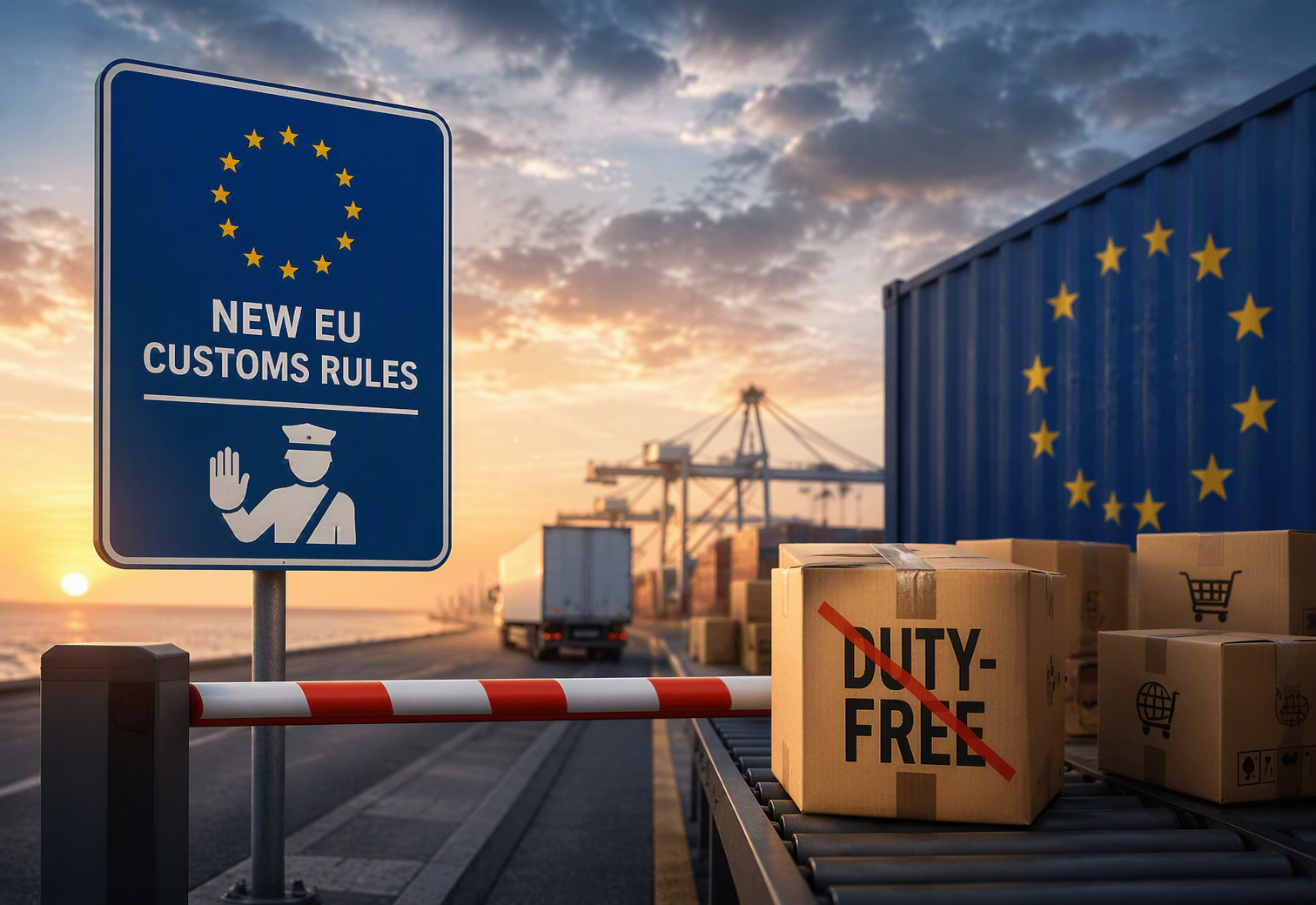
- From 1 July 2026, the EU will remove the €150 customs duty exemption and introduce a flat €3 customs duty on low-value imports, even where the Import One-Stop Shop (IOSS) scheme is used.
- The €3 charge applies per HS (tariff) code, not per parcel or per item — so mixed-product orders cost more than single-product orders.
- Several countries, including France, are layering on their own local handling fees, which stack on top of the EU-wide duty.
- Whether VAT is charged at checkout or at the border now depends heavily on whether you use IOSS and whether you absorb or recharge these new costs.
- The €3 duty is a temporary measure. From 2028, the EU Customs Data Hub is expected to remove the €150 threshold entirely, applying standard tariff treatment to all imports.
- Sellers have several strategic options going forward, from absorbing the new costs to shifting toward EU-based fulfilment.
- AVASK can help you review your HS codes, VAT setup, and fulfilment strategy ahead of the deadline.
What’s Actually Changing on 1 July 2026?
Starting July 1, 2026, the European Union is eliminating the long-standing “de minimis” exemption that previously allowed parcels valued at €150 or less to enter customs-free. In its place, the EU is introducing a mandatory flat €3 customs duty on all low-value goods, applied at the point of import. This change represents a significant shift for international commerce, as it mandates that even shipments handled through the Import One-Stop Shop (IOSS) for VAT purposes will now be subject to this additional customs fee.
The headline message for online sellers is clear: low-value parcels are no longer exempt from customs. Because this charge is unavoidable, sellers must act now to evaluate how these changes will impact their pricing strategies, VAT processes, and overall supply chain costs. Rather than reacting to these new rules once they take effect, businesses should proactively adjust their operations to maintain healthy margins and ensure a seamless experience for their EU customers.
Why Is the EU Making This Change?
This shift is a deliberate market correction. For years, non-EU sellers (particularly large platforms shipping from outside the bloc) have leaned on high parcel volumes and duty-free thresholds to keep landed costs low. Meanwhile, EU-based businesses importing stock in bulk have continued to pay full customs duties and absorb higher regulatory costs.
That gap created an uneven playing field. By introducing a flat charge on low-value imports, EU policymakers hope to:
- Level the competitive landscape between EU and non-EU sellers
- Discourage undervaluation and the deliberate splitting of shipments to dodge duty
- Ease the growing strain on customs systems, which currently process an enormous volume of small parcels
Put simply, this is less about raising revenue and more about closing a loophole that has shaped cross-border e-commerce for over a decade.
How Does the €3 Customs Duty Actually Work?
Here’s where many sellers get caught out: the €3 duty isn’t charged per parcel or per unit. Instead, it’s charged per HS (Harmonised System) tariff code within a consignment valued under €150.
That distinction matters enormously for product mix. Consider these two scenarios:
| Order Contents | Customs Duty |
|---|---|
| 3 × identical T-shirts (same HS code) | €3 |
| T-shirt + shoes + belt (three HS codes) | €9 |
So, an order containing several identical items costs far less in duty than a basket of different product types, even if the total value is the same. For sellers offering bundles or mixed baskets, this is a genuine reason to revisit product packaging and order structure.
Local Handling Fees Add Another Layer
As if a flat customs duty wasn’t enough to factor into your pricing, some EU member states are introducing their own local handling fees on top. France, for example, has confirmed an additional €2 fee and, like the EU-wide duty, it’s charged per tariff classification rather than per parcel.
These fees are entirely separate from VAT and the €3 duty, which means costs can stack up quickly. Here’s how that looks in practice:
| Scenario | €3 Duty | Handling Fee | Total |
|---|---|---|---|
| Same product order | €3 | €2 | €5 |
| Mixed basket | €9 | €6 | €15 |
The more complex the shipment, the steeper the cumulative cost. This is exactly why product mix and packing strategy deserve a fresh look before Q4 arrives.
VAT Mechanics: How IOSS Changes the Picture
For consignments under €150, the VAT outcome from here on depends largely on whether you use IOSS, and whether you choose to absorb or pass on the new duty and handling fees.
| Scenario | Where VAT is Charged | VAT Calculation Basis | Do Fees Increase VAT? | Customer Experience |
|---|---|---|---|---|
| Under €150 + IOSS, seller absorbs costs | Checkout | Amount charged to customer | No, provided fees aren’t recharged | VAT paid at checkout; no surprise charges on delivery |
| Under €150 + IOSS, seller recharges costs | Checkout | Amount including recharged fees | Yes, if added to the selling price | Customer sees full landed cost upfront |
| Under €150 + no IOSS | Import/border | Customs value plus duties and charges | Yes, import VAT includes duties | Customer may face VAT and fees at delivery |
The takeaway here is nuanced but important: under IOSS, duty and handling fees only push up the VAT bill if you choose to recharge them to the customer. If you absorb those costs yourself, your checkout VAT stays unaffected, though, of course, your margin takes the hit instead.
What This Means Strategically for Your Business
This is no longer purely a tax or compliance issue; it’s a pricing and supply-chain decision. Businesses now need to revisit:
- Margin assumptions on low-value baskets, particularly bestsellers priced near impulse-buy thresholds
- Whether mixed-product baskets still make commercial sense, given the per-HS-code charge structure
- Whether to absorb, recharge, or restructure the supply chain altogether to minimise repeated import costs
In short, the businesses that adapt their pricing and logistics strategy early will be far better positioned than those who wait until the rules take effect.
Strategic Adaptation: EU Storage & OSS
To mitigate the impact of the new €3 customs duty, consider shifting your logistics strategy from direct-to-consumer shipping to a local fulfilment model. By storing inventory within the EU and utilising Amazon FBA or a specialised third-party logistics (3PL) provider, you can transform your supply chain efficiency.
- Optimise Customs Costs: Instead of paying the €3 duty per parcel, import goods in bulk to a local warehouse. This consolidates customs clearance into a single event, significantly reducing the per-unit duty cost.
- Boost Marketplace Competitiveness: Local fulfilment enables faster shipping speeds, which is critical for maintaining high rankings and customer satisfaction on European marketplaces.
- Streamline Compliance: Utilise the One-Stop Shop (OSS) scheme to handle VAT reporting for intra-EU sales through a single, consolidated return, reducing administrative overhead.
- Action Plan: Analyse your current sales volume and average order value by country. If you have consistent demand in specific EU regions, transition your high-velocity SKUs to local warehousing to maximise these margin-saving benefits.
Looking Ahead: What Happens After 2028?
It’s worth remembering that the €3 duty is explicitly described as a temporary, transitional measure. Once the EU Customs Data Hub regime comes into force, the €150 threshold is expected to disappear altogether, with imports moving to standard, tariff-based treatment.
| Phase | Position |
|---|---|
| 2026–2028 | Temporary €3 low-value customs duty regime |
| 2028 onwards | Full tariff-based customs treatment once the threshold disappears entirely |
July 2026 shouldn’t be treated as the finish line. Rather, it’s the first stage of a much broader customs redesign and businesses that build flexible, scalable compliance processes now will be far better placed to handle the next round of changes when 2028 arrives.
AVASK’s Expert Support
Navigating these regulatory changes requires precision; errors in HS code classification or VAT registration can lead to costly parcel delays and diminished customer trust. AVASK’s cross-border VAT and customs specialists can review your current setup, audit your HS codes for accuracy, register for OSS, and help you decide whether absorbing, recharging, or restructuring your fulfilment model makes the most sense for your business.
| New sellers looking to ship Amazon inventory can currently save up to €380! AVASK and Amazon Customs Clearance and Shipping Services (C2S2) utilise a per-shipment (not per-item) brokerage pricing structure. Consolidating inventory into bulk shipments (small parcels or pallets) minimises the per-item cost impact compared to direct-to-consumer shipping. Start shipping with C2S2 |
Don’t let new customs rules derail your H2 profits.
Navigating new EU customs changes doesn’t have to slow your momentum. Partner with AVASK to turn compliance into your competitive advantage. Contact AVASK today for a full compliance review and discover how our tech-driven solutions can prep your business for massive Q3 and Q4 growth.
When does the EU’s new €3 customs duty take effect?
The new flat customs duty applies to low-value consignments entering the EU from 1 July 2026 onward.
Does using IOSS mean I avoid the new €3 duty?
No. Even where IOSS is used to simplify VAT collection, the €3 duty still applies to qualifying low-value imports.
Is the €3 duty charged per parcel?
No. It’s charged per HS (tariff) code within a shipment, not per parcel or item. A box containing several different product types will incur the duty multiple times.
Will every EU country charge the same fees?
The €3 duty is EU-wide, but some countries — France being one current example — are adding their own local handling fees on top, so total costs can vary by destination.
Is this change permanent?
Not exactly. The €3 duty is intended as a transitional measure until the EU Customs Data Hub regime takes effect around 2028, after which the €150 threshold is expected to be removed entirely in favour of standard tariff treatment.
How can I reduce the impact of these new charges?
Options include absorbing the costs to protect the customer experience, recharging customers at checkout for full price transparency, or moving toward EU-based fulfilment to avoid repeated per-order import charges altogether. The right choice depends on your margins, product range, and growth plans.
Do I still need to register for IOSS if I sell low-value goods into the EU?
IOSS remains a valuable tool for simplifying VAT collection on B2C sales under €150, even though it no longer guarantees duty-free entry. Getting your VAT registration and reporting right is still essential for smooth, compliant trading.


