











Table of Contents
Toggle


QUICK ANSWER
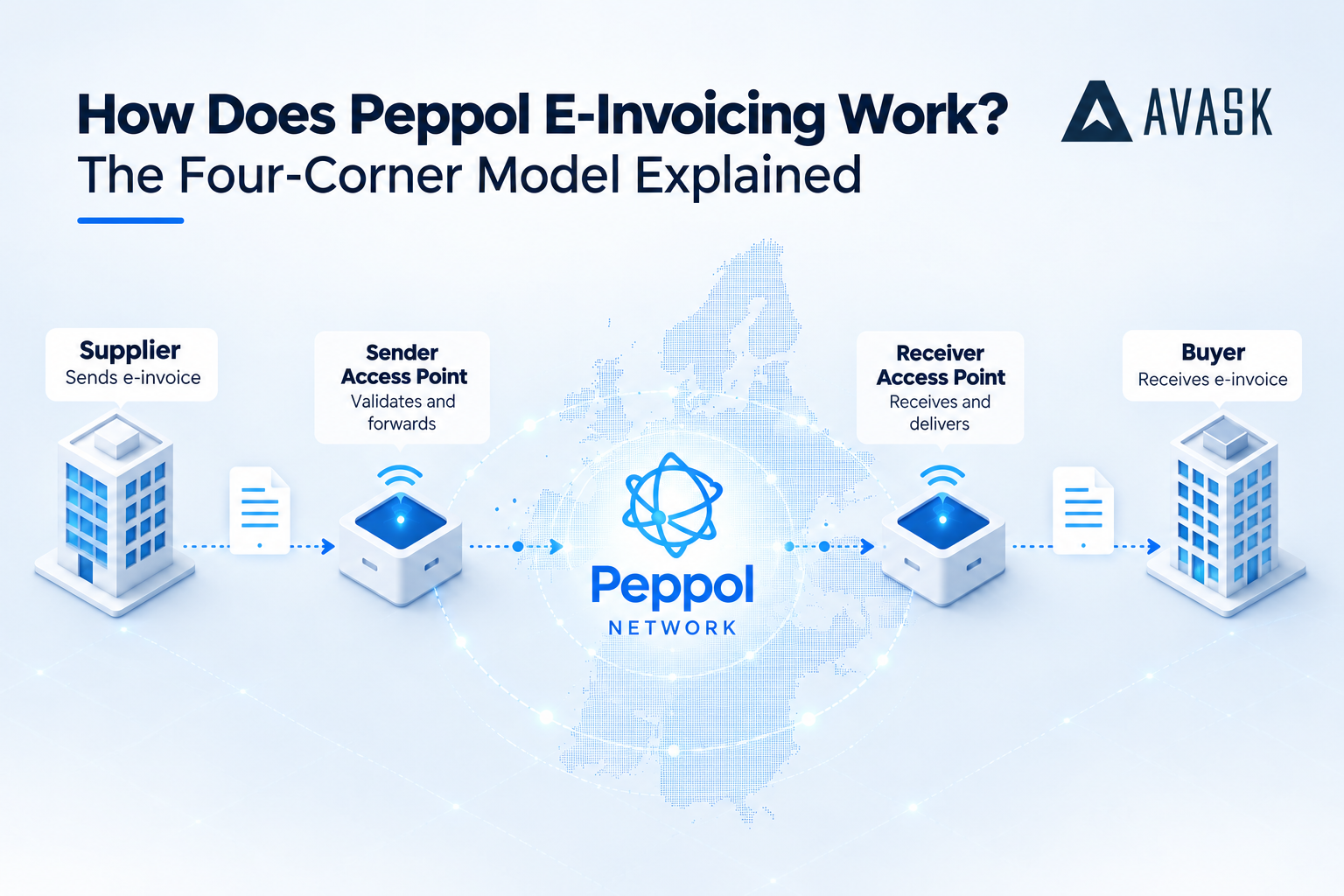
Peppol e-invoicing is the exchange of structured, machine-readable invoices over the Peppol network using a four-corner model. You (corner 1) send the invoice from your software to your certified Access Point (corner 2), which finds your customer’s Access Point (corner 3) and delivers it securely to your customer (corner 4). The UK has named Peppol as the core network for its April 2029 e-invoicing mandate.
In the UK, Peppol was for years something only NHS suppliers and public-sector contractors had to think about. That changed in 2026: Belgium made Peppol e-invoicing the rule for domestic B2B trade, and the UK confirmed Peppol as the core network for the e-invoicing mandate that starts in April 2029.
Most explanations of Peppol are written by companies that sell a connection to it. This one isn’t. It explains how Peppol e-invoicing works — the four corners, the lookup in between and the standards behind them — then answers the question that matters if you sell across borders: which of your invoices will travel over Peppol, where, and when. (If you’re still deciding whether e-invoicing is worth it, start with the benefits of e-invoicing.)
| PEPPOL IN 2026: WHAT’S CHANGED1 Jan 2026 — Belgium: structured B2B e-invoices become mandatory for Belgian businesses, with Peppol as the default network.23 Jun 2026 — UK: the government names Peppol as the core interoperability network for e-invoicing.1 Jul 2026 — UAE: a pilot with selected taxpayers opens for the UAE’s Peppol-based five-corner model.Aug–Sep 2026 — the network itself: OpenPeppol takes over the central Service Metadata Locator from the European Commission.1 Sep 2026 — France: the e-invoicing reform goes live for businesses established in France.Next: the UK’s e-invoicing roadmap is due at Budget 2026.Last updated: 25 Sep 2026 |
Table of Contents
ToggleWhat is Peppol e-invoicing?
Peppol e-invoicing is the sending and receiving of electronic invoices in one standard structured format across the Peppol network: an open, international network in which certified Access Points exchange documents on behalf of businesses and public bodies, so that any connected sender can reach any connected receiver.
Peppol is not software, a single file format or a law. It is three things working together: a network of certified service providers, a set of document specifications every provider must support, and a framework of agreements that holds everyone to the same rules.
The name originally stood for Pan-European Public Procurement Online. Peppol began in 2008 as a large-scale pilot co-financed by the European Commission to make cross-border public procurement easier. In 2012 its services passed to OpenPeppol, a non-profit international association established under Belgian law, which still governs the framework today. National Peppol Authorities — such as FPS BOSA in Belgium, the Australian Taxation Office and, for NHS England, Supply Chain Coordination Ltd — run Peppol in their own jurisdictions.
As a business, you don’t join OpenPeppol and you don’t plug into the network directly: OpenPeppol states that buyers and suppliers do not need to become members to use it. You connect through a certified Peppol Service Provider, usually called an Access Point. And Peppol invoicing covers more than invoices: the same network carries credit notes, purchase orders, despatch advice and invoice responses.
How does Peppol e-invoicing work? The four-corner model
Peppol is built on what’s known as the four-corner model (or 4-corner model). Every invoice passes through four parties, and each has one job.
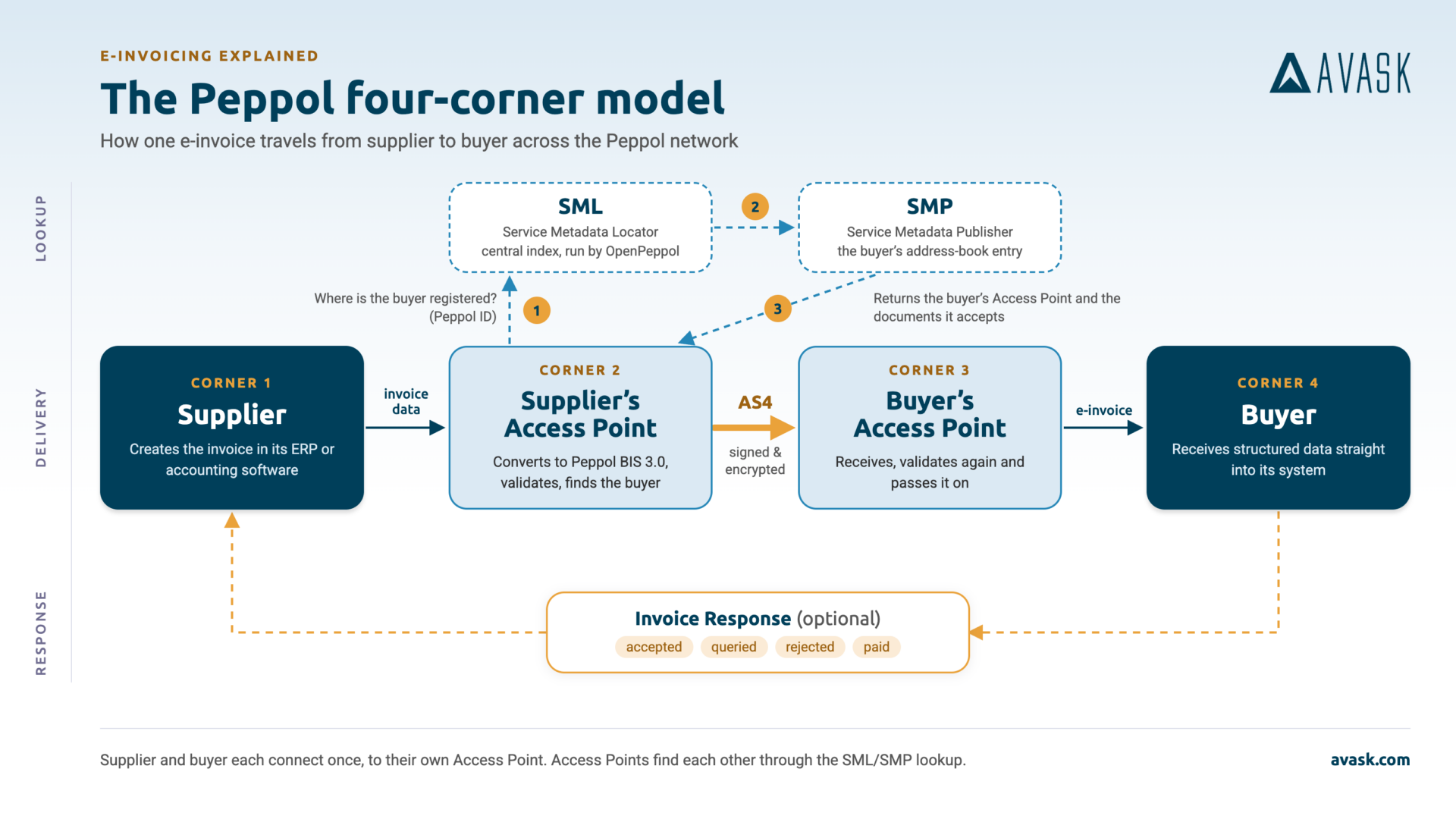
The Peppol e-invoicing network diagram: supplier and buyer each connect once, to their own Access Point. The Access Points find each other through the SML/SMP lookup and exchange the invoice over AS4.
| Corner | Who | What it does |
|---|---|---|
| 1 | Supplier (sender) | Creates the invoice in its ERP or accounting software, or in its Access Point’s web portal. |
| 2 | Supplier’s Access Point | Converts the invoice into the Peppol format, validates it, finds the buyer and sends it. |
| 3 | Buyer’s Access Point | Receives the invoice, validates it again and passes it on. |
| 4 | Buyer (receiver) | Receives the invoice directly into its own finance system, ready to process. |
Why four corners and not three
Before Peppol, most e-invoicing networks were closed three-corner models: supplier and buyer both had to use the same provider, so a supplier with customers on ten different platforms needed ten connections. Peppol separates the network from the providers. In OpenPeppol’s words, “a single Peppol-accredited Service Provider is all you need to reach all organisations on our global network”.
Mobile phones are the easiest comparison. You and the person you’re calling can be with different carriers, yet the call connects because every carrier follows the same rules. Your Access Point is your carrier, and Peppol is the phone system. The Australian Taxation Office, which is Australia’s Peppol Authority, has a clear walkthrough of how the four corners work.
The journey of one Peppol invoice, step by step
Here’s what happens between clicking ‘send’ and the invoice appearing in your customer’s system. Most of it takes seconds.
- You create the invoice. Your ERP or accounting software (corner 1) produces the invoice data, or you key it into your provider’s portal.
- Your Access Point converts and validates it. Corner 2 maps the data into Peppol BIS Billing 3.0 and checks it against the specification’s business rules: mandatory fields, calculations and code lists. An invoice that fails is rejected back to you before it leaves.
- Your Access Point looks up your customer. Using your customer’s Peppol ID, corner 2 asks the central Service Metadata Locator (SML) where that customer’s details are held. The SML points to a Service Metadata Publisher (SMP), which returns the address of your customer’s Access Point and the document types it can accept.
- The invoice is sent over AS4. Corner 2 transmits the invoice to corner 3 using AS4, a secure messaging protocol, signed and encrypted with Peppol digital certificates so both sides know exactly who they’re dealing with.
- Your customer’s Access Point validates and acknowledges it. Corner 3 checks the invoice again and confirms receipt.
- The invoice lands in your customer’s system. Corner 4 receives structured data it can process automatically, with no scanning or re-keying.
- A response may come back. If both sides support it, your customer can return a Peppol Invoice Response telling you the invoice has been accepted, queried, rejected or paid.
What a Peppol ID looks like
Every business on the network is identified by a Peppol participant identifier, written as a scheme code followed by a value. A UK business can be identified by its VAT number under scheme 9932, a Belgian business by its enterprise number under scheme 0208, and many NHS suppliers by a GS1 Global Location Number under scheme 0088. Your Access Point registers your ID for you; our step-by-step guide explains how to get a Peppol ID.
| UNDER THE BONNETTwo lines of the invoice XML do most of the work: the rulebook the invoice follows, and the buyer’s Peppol ID used in the step 3 lookup: <cbc:CustomizationID>urn:cen.eu:en16931:2017#compliant#urn:fdc:peppol.eu:2017:poacc:billing:3.0</cbc:CustomizationID><cbc:EndpointID schemeID=”0208″>0123456749</cbc:EndpointID> |
The building blocks behind the four corners
You don’t need to manage any of this yourself, because your Access Point does it for you. But knowing the parts of the Peppol system helps you ask providers the right questions.
| Component | What it does | Who runs it |
|---|---|---|
| Access Point (Service Provider) | Connects a business to the network; converts, validates, sends and receives documents | Commercial providers certified under the Peppol framework |
| SML (Service Metadata Locator) | Central index that tells an Access Point which SMP holds a participant’s details | OpenPeppol (taken over from the European Commission in 2026) |
| SMP (Service Metadata Publisher) | Address book listing each participant’s Access Point and the documents it accepts | Service providers (decentralised) |
| Peppol ID | Unique identifier for each participant, such as a VAT or company number | Registered by your Access Point |
| Peppol Directory | Free, searchable list of participants that publish a business card | OpenPeppol |
| Peppol BIS Billing 3.0 | The specification for invoices and credit notes, based on EN 16931 and UBL 2.1 | OpenPeppol |
| AS4 and certificates | Secure transport between Access Points | Peppol framework (mandatory since February 2020) |
Access Points. Businesses use a certified Access Point rather than building their own because certification, testing and security infrastructure are costly to maintain. OpenPeppol publishes the list of certified Peppol Service Providers; AVASK is independent of all of them.
Standards. The Peppol BIS Billing 3.0 specification is a core invoice usage specification of EN 16931, the European e-invoicing standard, written in UBL 2.1 XML, so a compliant Peppol invoice also meets the EU standard. Outside Europe, countries such as Australia, New Zealand, Japan, Singapore, Malaysia and the UAE use Peppol International (PINT) specifications adapted to local tax rules.
Lookup. In 2026 OpenPeppol took over the SML from the European Commission, so guides naming the Commission as its operator are out of date. You can search the Peppol Directory for a customer, but not every business publishes a listing, so if you can’t find one, ask for their Peppol ID.
Four corners, five corners: where the tax authority comes in
The four-corner model moves invoices between businesses. Tax authorities increasingly want to see that data as well, and the Peppol model can be extended to give it to them.
| Model | How it works | Does the tax authority see invoices? | Examples |
|---|---|---|---|
| Three-corner | Supplier and buyer use the same provider or platform | No (unless reported separately) | Closed supplier portals; most pre-Peppol networks |
| Four-corner | Each side uses its own Access Point, and the providers interoperate | No — invoices pass only between businesses | Australia, New Zealand, Belgium today, the UK at launch in 2029 |
| Five-corner | Four-corner exchange, plus invoice data reported to the tax authority as the fifth corner | Yes — at or near the time of the transaction | Singapore (InvoiceNow), UAE (from 2027) |
In a five-corner model, the Access Points send a copy of the invoice data to the tax authority. Singapore’s tax authority describes its InvoiceNow requirement as adding “a 5th corner to the 4-corner model”; it is being phased in for GST-registered businesses and will cover all of them by 1 April 2031. The UAE’s Peppol-based model becomes mandatory from 1 January 2027 for businesses with revenue of AED 50 million or more, and from 1 July 2027 for other businesses, with government entities following on 1 October 2027. Belgium plans to add e-reporting on top of its Peppol mandate from 2028.
By contrast, the Australian Taxation Office does not receive copies of eInvoices, and the UK won’t introduce real-time reporting alongside its 2029 mandate. France takes a hybrid route: approved platforms exchange invoices and report the data (see France’s approved-platform model).
At EU level, the VAT in the Digital Age (ViDA) package, adopted in March 2025, makes structured e-invoicing the default and brings digital reporting for cross-border B2B transactions from 1 July 2030 (European Commission), and some EU countries, such as Belgium, already plan reporting on top of their Peppol exchange.
Peppol is a network, not a mandate: where your invoices will actually use it
This is where most guides blur the picture. Peppol is a delivery network; a mandate is a legal obligation. Some mandates require Peppol, some accept it as one channel among several, and some don’t use it at all. And if you sell across borders, where you’re established usually matters more than where you’re VAT-registered.
| Country | E-invoicing obligation | Role of Peppol | If you’re only VAT-registered there (not established) |
|---|---|---|---|
| United Kingdom | All VAT invoices (B2B and B2G) electronic from April 2029 | Core interoperability network | Not yet confirmed — expected to be addressed in the roadmap due at Budget 2026 |
| Belgium | Structured B2B e-invoices mandatory since 1 January 2026 | Default network | Out of scope without a Belgian permanent establishment |
| Germany | Receive since 1 January 2025; issue from 2027 (turnover over €800,000) and 2028 (all) | Optional: one accepted transmission route alongside email and others (formats include XRechnung, ZUGFeRD and Peppol BIS) | Out of scope — a German VAT number alone doesn’t make you domestic |
| France | All established businesses receive from 1 September 2026; issue from 2026 (large and mid-sized) or 2027 (SMEs) | Approved platforms exchange invoices; Peppol is one interoperable route | Outside e-invoicing, but e-reporting applies: from 1 September 2026 (large and mid-sized) or 1 September 2027 (SMEs) |
| Poland | KSeF mandatory in phases from 1 February 2026 | Not used — KSeF is a central government platform | Not mandatory without a fixed establishment in Poland |
Two practical points if you sell online:
- B2C sales sit outside these e-invoicing obligations. Consumer sales through Amazon or your own store aren’t covered by any mandate in the table (though France’s separate e-reporting covers B2C sales liable to French VAT, including by non-established sellers not registered for OSS). Your exposure is B2B and public-sector invoicing.
- Your customers may pull you in before the law does. Belgian businesses must receive structured e-invoices, and NHS buyers in England already use Peppol. Even without a mandate, sending over Peppol can become a commercial requirement.
For the full picture, see which countries have mandatory e-invoicing, plus our country guides to Germany’s e-invoicing mandate and Poland’s KSeF system. If you’re expanding into Europe or the UK, this is the map to check first.
| AVASKNot sure which of these rules reach your business?AVASK maps your entities, registrations and transaction flows against the rules that actually reach them, then tells you which markets need work and in what order. No software purchase required to find out.Book an e-invoicing readiness review → |
Peppol in the UK: what the April 2029 mandate means
The UK has used Peppol for more than a decade without most businesses noticing. The NHS in England adopted GS1 and Peppol standards in its 2014 eProcurement Strategy, so many healthcare suppliers already invoice over the network. What’s new is that Peppol is on course to reach every VAT-registered business that invoices other businesses.
What has been decided
- At Autumn Budget 2025, the government announced that all VAT invoices in B2B and B2G transactions must be issued electronically from 2029 (consultation response), and HMRC has since confirmed April 2029 as the implementation date. Invoices to consumers are not included.
- The UK will use a decentralised model: invoices move between businesses’ own providers, not through an HMRC platform.
- On 23 June 2026, the government named Peppol as the core interoperability network for e-invoicing in the UK.
- There will be no real-time reporting to HMRC when the mandate starts. The government says it will continue to explore it, so a five-corner model later on isn’t ruled out.
What is still open
- HMRC is working with the Department for Business and Trade on an e-invoicing roadmap due at Budget 2026, which will set out the milestones to April 2029.
- Who will act as the UK-wide Peppol Authority.
- Exactly how businesses must connect to Peppol, and whether any obligations are phased in.
- How the mandate treats businesses that are VAT-registered in the UK but not established here, such as overseas marketplace sellers. Nothing published so far answers this, so be wary of any guide that says it does.
Until then, e-invoicing in the UK stays voluntary, except where a buyer such as the NHS requires it.
What Peppol doesn’t do (and where compliance still breaks)
Peppol is very good at one thing: getting a well-formed invoice from your system into your customer’s, securely and quickly. Its validation checks that the invoice is complete and correctly structured, not that it’s right. Peppol won’t tell you that:
- you’ve charged the wrong VAT rate, or should have applied the reverse charge;
- a sale should have gone through OSS, or needed a VAT registration you don’t have;
- your customer’s VAT number, legal name or address in your system is out of date;
- the invoice is missing details that local VAT law requires.
A Peppol invoice with the wrong VAT treatment is delivered perfectly and is still wrong. In a five-corner country, the tax authority receives the error at the same moment as your customer. Peppol compliance is not VAT compliance. Your invoices still have to meet the rules on what a UK VAT invoice must contain, and the VAT registration and filing behind them still has to be right.
That’s the part AVASK works on. AVASK is not an e-invoicing software vendor and not a Peppol Access Point. We advise on which rules apply to your business, review your invoice data against your VAT position, and help you scope the change, independently of whichever provider you choose. On the AVASK platform, invoice data, tax reporting and reconciliation sit in one environment, with native API connections to Amazon, Shopify and more than 20 other platforms.
| AVASKFix the data before you connect the pipeBefore you choose an Access Point, check that your VAT treatment, customer records and invoice data will pass structured validation in every market you sell into.Book an e-invoicing readiness review →See the platform → |
How to get connected to Peppol
Connecting is usually the easy part. The order you do it in matters more than the tool you pick.
- Map where you need it. List the entities, customers and countries where you issue or receive B2B and B2G invoices, and check which obligations apply. The country table above is a starting point.
- Choose a certified provider. Options range from connectors built into ERP and accounting software to web portals for low volumes. Choose one from the OpenPeppol list of certified Service Providers that supports both sending and receiving in your markets.
- Get your Peppol ID. Your provider registers you on the network. Our guide covers how to get a Peppol ID in detail.
- Test with your key customers. Send test invoices to your largest customers, confirm they arrive and are processed, and make sure your team knows where incoming Peppol invoices land.
Frequently asked questions
Is Peppol mandatory in the UK?
Not yet for most businesses. From April 2029, all VAT invoices between businesses and to the public sector must be issued electronically, and the government has named Peppol as the core interoperability network. How businesses must connect will be set out in the roadmap due at Budget 2026. Many NHS suppliers already invoice via Peppol.
Is Peppol free to use?
OpenPeppol doesn’t charge businesses to use the network, and membership isn’t required. You pay your Access Point provider; pricing varies, typically a subscription, a per-document fee or both.
Which countries use Peppol?
Peppol is used across Europe and in Asia-Pacific countries including Australia, New Zealand, Singapore, Japan and Malaysia, and the UAE is adopting a Peppol-based model. The Australian Taxation Office reports more than 3.5 million businesses in more than 100 countries registered on the network. See which countries have mandatory e-invoicing.
What does Peppol stand for?
Originally Pan-European Public Procurement Online, the EU-funded project it grew out of. Today Peppol is a name in its own right: the network has outgrown both Europe and public procurement.
Do I need to change my accounting software to use Peppol?
Usually not. Most Access Points connect to common ERP and accounting systems or offer a web portal. What often needs to change is the data: VAT codes, customer identifiers and fields that were fine on a PDF can fail structured validation.
What's the difference between Peppol and EDI?
Traditional EDI links two trading partners through a bilateral set-up, often with custom mappings for each relationship. Peppol uses open standards and a shared network, so one connection reaches every participant. Many businesses run both.
What if my customer isn't on Peppol?
Check the Peppol Directory or ask for their Peppol ID. If they aren’t connected and no mandate applies, keep invoicing them as you do now. Where a mandate applies, as between Belgian businesses, both sides must exchange structured e-invoices.
Can I still send PDF invoices?
In the UK, yes, until the mandate takes effect in April 2029. A PDF isn’t a structured e-invoice, though, so it won’t satisfy a mandate such as Belgium’s, where structured e-invoices are required for domestic B2B trade.
I'm an AVASK client — how can AVASK help?
Speak to your account manager. We’ll map which of your entities and markets fall under a mandate, review your invoice data against your VAT position and tell you what must change before you connect a provider.
I'm not an AVASK client — can AVASK still help?
Yes. Book an e-invoicing readiness review and we’ll assess your exposure across the UK, the EU and the other markets you sell into, independently of any software provider.
One platform. Every obligation. One view
Peppol will carry more of your invoices every year. Whether those invoices are right is still up to you. Work out which rules reach your business before you choose a provider, and you’ll only need to connect once.
Get e-invoicing ready with AVASK
Find out which e-invoicing mandates apply to your entities and markets, and what has to change in your invoice data before they do.


