











Table of Contents
Toggle


Table of Contents
ToggleQuick Answer
- PPWR (Regulation (EU) 2025/40) entered into force on 11 February 2025 and applies across the EU from 12 August 2026, replacing the old Packaging and Packaging Waste Directive (94/62/EC).
- Unlike a directive, PPWR is a regulation, so it applies directly and identically in all 27 EU Member States, with no room for individual national interpretation.
- The regulation covers all types of packaging placed on the EU market, including sales, transport, and e-commerce packaging, regardless of material.
- Core goals include making all packaging recyclable by 2030, cutting excess packaging and empty space, boosting recycled plastic content, and expanding reusable packaging systems.
- PPWR does not replace EPR; instead, it strengthens it. Producers must still register and report packaging data, and EPR fees will increasingly be modulated based on how recyclable your packaging is.
- Businesses should start preparing now: audit your packaging, map your obligations country by country, and speak with suppliers about redesigning for compliance.
- AVASK’s EPR and compliance specialists can help you register, report, and stay ahead of these changing rules before the deadline arrives.
What Is the PPWR?
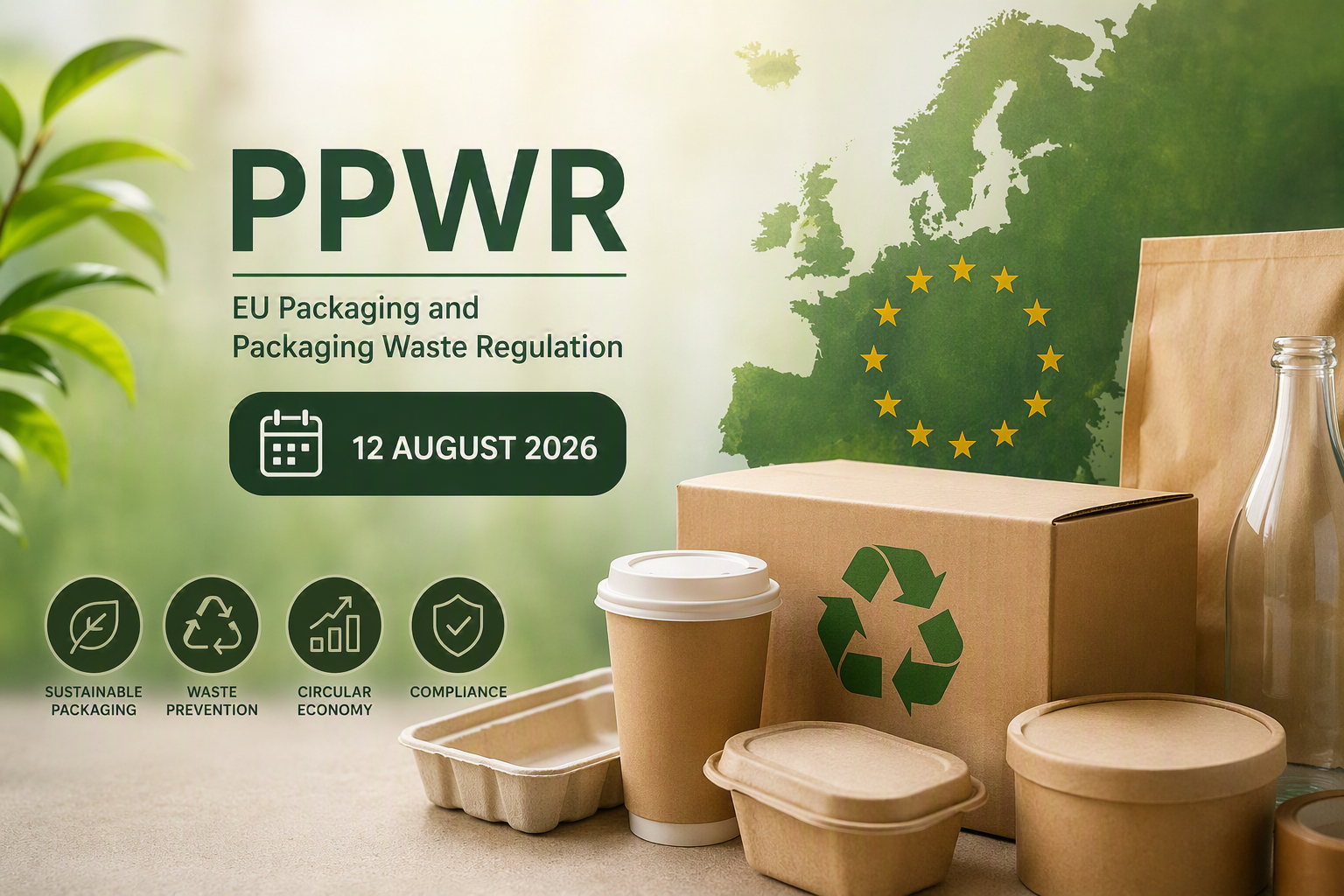
The Packaging and Packaging Waste Regulation, better known as PPWR, is the EU’s new law governing the design, use, and disposal of packaging. It entered into force on 11 February 2025 and, after an 18-month transition period, it will become fully applicable on 12 August 2026.
Put simply, PPWR is the EU’s answer to the growing problem of packaging waste. It sets out to:
- Make all packaging placed on the EU market recyclable in an economically viable way by 2030.
- Increase the amount of recycled plastic used in new packaging.
- Reduce the volume of unnecessary or oversized packaging, including single-use formats.
- Support the EU’s broader circular economy goals, with climate neutrality targeted for 2050.
Because PPWR is a regulation rather than a directive, it doesn’t need to be transposed into national law. That means the same rules apply consistently, whether you’re shipping into France, Germany, or Poland. This is a deliberate move to close the gaps left by the old Packaging Waste Directive, where enforcement and interpretation varied widely across countries.
PPWR Compliance Timeline at a Glance
PPWR compliance doesn’t arrive all at once. Instead, it rolls out in stages, so it helps to know which milestones matter most for your business:
- 11 February 2025 – PPWR enters into force, officially replacing the old Packaging Waste Directive.
- 12 August 2026 – The regulation becomes fully applicable across all EU Member States, including PFAS restrictions in food-contact packaging and initial labelling rules.
- 2028 – The EU composting standard takes effect, and new limits on empty space in grouped, transport, and e-commerce packaging begin to apply.
- 2030 – Recyclability grading, minimum recycled plastic content targets, and reuse obligations for beverage containers and transport packaging come fully into force, alongside bans on certain single-use plastic formats.
- 2038 and beyond – Stricter recyclability obligations tighten further, pushing the EU closer to its circular economy goals.
Because these dates are spread out, it’s easy to assume you have plenty of time. In reality, though, packaging redesign, supplier negotiations, and EPR registration all take time to sort out properly, so working toward PPWR compliance early puts you well ahead of the curve.
Who Does PPWR Apply To?
PPWR casts a wide net. If your business fits any of the following roles, the regulation likely applies to you:
- Manufacturers who design and produce packaging.
- Importers, who bring packaged goods into the EU from outside.
- Distributors and retailers, including online marketplaces and fulfilment providers.
- Sellers placing products on the EU market, whether through their own store or via platforms such as Amazon, eBay, or Shopify.
In other words, almost anyone in the supply chain has some role to play. It’s worth noting that your specific obligations will depend on which of these roles you occupy in each country you sell to, so a single business might be a “producer” in one Member State and a “distributor” in another.
The Main Requirements of PPWR
1. Recyclability by Design
From 2030 onwards, all packaging placed on the EU market must be recyclable. The European Commission is developing detailed criteria and a recyclability grading system, so packaging that’s hard to recycle will eventually cost more to place on the market through modulated EPR fees.
2. Recycled Content in Plastic Packaging
Plastic packaging will need to include a minimum share of recycled post-consumer plastic. The exact percentage can vary by Member State, though certain categories, such as infant food packaging or pharmaceutical packaging, are exempt.
3. Minimisation and No More “Empty Space”
Packaging must be designed to use the least material and volume possible while still doing its job. That means no more deceptive packaging, such as false bottoms or oversized boxes that make a product look bigger than it is. By 2030, packaging must not contain more than 50% empty space, according to the European Commission’s own guidance.
4. Reusable Packaging Targets
Certain categories, particularly beverage containers and transport packaging like pallets, crates, and trays, will need to meet reuse targets from 2030. This links closely with EPR, since final distributors will likely contribute to the cost of achieving these targets once further guidance is published.
5. Restrictions on Certain Single-Use Formats
From 1 January 2030, some single-use plastic packaging formats will be banned outright, including small plastic sachets for condiments in the hospitality sector. Businesses in food service and retail should start reviewing alternatives now rather than waiting for the deadline.
6. Labelling and Substances of Concern
PPWR introduces harmonised labelling requirements to help consumers correctly sort packaging waste. It also restricts substances of concern, including PFAS (“forever chemicals”), in food-contact packaging, with strict concentration limits taking effect from August 2026.
How Does PPWR Relate to EPR?
This is one of the most common points of confusion, so it’s worth spelling out clearly:
- PPWR sets the rules for how packaging must be designed, what it can be made of, and how much of it you can use.
- EPR (Extended Producer Responsibility) is the registration and reporting system used to fund the collection, sorting, and recycling of that packaging once it becomes waste.
Rather than replacing EPR, PPWR strengthens and standardises it. Producers must register with national authorities, report data on the volume, weight, and materials of their packaging, and pay fees that fund end-of-life waste management. Increasingly, those fees will be modulated: packaging that’s harder to recycle, or made from less sustainable materials, will attract higher charges. This links the design choices you make today directly to the compliance costs you’ll face tomorrow.
PPWR vs. EPR: What’s the Difference?
| Feature | Focus | Goal | Relationship |
|---|---|---|---|
| PPWR | Technical design, recyclability, and waste prevention. | Ensuring packaging is sustainable by design. | PPWR dictates what kind of packaging is allowed to be reported. |
| EPR | Financial accountability and data reporting. | Funding the collection and recycling of packaging. | You report your data via EPR schemes. |
Think of it this way: PPWR sets the rules for how your product should be “built” for the planet, while EPR is the system you use to pay your dues for the waste generated.
What About Amazon’s Pay-On-Behalf (POB) Programme?
Many Amazon sellers already use the Pay-On-Behalf programme to simplify EPR obligations, and it remains a useful tool under PPWR too. POB allows Amazon to handle certain EPR packaging fees on your behalf, reducing some of the administrative burden.
However, POB doesn’t cover everything. In several countries, sellers are still required to appoint an Authorised Representative to manage local compliance obligations. If you rely solely on POB without checking country-specific requirements, you could still fall short of full compliance. It’s worth reviewing your obligations market by market rather than assuming POB has you covered everywhere.
Practical Steps to Prepare for PPWR
With the 12 August 2026 deadline approaching fast, here’s a practical checklist to work through:
1. Audit Your Packaging: Reduce weight, simplify materials, and remove unnecessary features to lower EPR fees.
2. Map Your Country Obligations: List every EU country you currently sell into and define your role in each to clarify responsibilities. This is particularly important for Amazon sellers using multiple fulfilment centres across Europe.
3. Align with Suppliers: Make sure they understand your design requirements and can provide documentation to prove compliance.
4. Register for EPR: Even before PPWR fully applies, EPR registration is already mandatory in many EU countries.
5. Stay Updated on National Rules: While PPWR applies uniformly as an EU regulation, national authorities are still finalising details around enforcement, penalties, and local registration systems. Staying updated will help you avoid surprises.
Why Getting PPWR and EPR Compliance Right Matters
Non-compliance isn’t just a paperwork problem. Goods that don’t meet PPWR requirements can be rejected at EU borders, and unregistered EPR obligations can lead to fines or a ban from selling in certain markets altogether. For growing e-commerce businesses, that kind of disruption can be costly, both financially and reputationally.
The good news is that with the right preparation, PPWR and EPR compliance can become a fairly straightforward part of your operations, rather than a last-minute scramble. Businesses that start reviewing their packaging and registration status now will be in a far stronger position come August 2026.
| Get Expert EPR Compliance Support Stay ahead of regulations and grow your business with AVASK’s expert EPR compliance service. We handle registration, reporting, and packaging obligations in every country you sell, so you’re always compliant and free to focus on what matters most. As PPWR frameworks evolve, we proactively expand our support and keep you informed at every stage. Stay EPR Compliant |
Ready to get ahead of the 12 August 2026 deadline?
Navigating EPR compliance and now PPWR requirements across multiple EU countries can feel overwhelming, especially if you’re managing it alongside day-to-day operations. Contact AVASK today to review your obligations and find out how we can support your business through this transition.


