











Table of Contents
Toggle


QUICK ANSWER
Sales tax and VAT compliance software covers two different jobs: calculating and filing US sales tax where you have nexus, and registering for, charging and filing VAT in the UK and EU. Few tools do both equally well. US sellers usually pick one of three setups, and the deciding question is who files each return, not who calculates the rate.
- One global tax engine (Avalara, Sovos, Vertex): the widest coverage, with enterprise pricing and setup.
- Two specialists (a US sales tax tool plus a UK/EU VAT provider): the most common setup, with two logins and two deadline calendars.
- One partner for both (for example AVASK with the Infiniti3 platform): one team registers and files on both sides; check which parts run in software and which are a managed service.
You hit economic nexus in a handful of states, your sales tax finally runs on autopilot, and now Amazon.co.uk or Amazon.de is next. This is where many US sellers find out that the tool they use for sales tax doesn’t do VAT, or does the math but not the registrations, returns and tax-office letters that VAT actually involves.
This guide is for US ecommerce and Amazon sellers of physical goods who already collect sales tax and are adding the UK or EU. It covers what changes when you cross the Atlantic, what a sales tax tool does and doesn’t do for VAT, the three ways to run both, and how the main sales tax and VAT compliance software options compare. If you are still working out where you owe US tax, start with when US economic nexus kicks in.
Disclosure: AVASK provides one of the options compared here (the Infiniti3 platform plus managed compliance). We checked every competitor fact on the vendor’s own website on 28 September 2026, and we link to government sources for the rules.
Table of Contents
ToggleSales tax vs VAT: why one tool rarely covers both well
US sales tax and VAT are both consumption taxes, but they ask very different things of your software. Sales tax is charged once, at the final sale, by states and local governments. VAT is charged at every stage by national governments, and it comes with registrations, local-format returns, invoice rules and evidence that a sales tax engine was never built to produce.
| US sales tax | UK and EU VAT | |
|---|---|---|
| Who levies it | States and local jurisdictions | National governments (HMRC in the UK; each of the 27 EU member states) |
| What makes a US seller liable | Economic nexus (sales thresholds) or physical nexus, such as inventory in a state | Making taxable supplies in the country, such as selling from stock held there |
| Threshold for a foreign seller | Yes, set state by state | UK: none for non-UK businesses. EU: the €10,000 threshold is for EU-established sellers only |
| When it is charged | Once, on the sale to the end customer | At every stage, on business and consumer sales |
| Returns | State returns, monthly to annually | UK returns under Making Tax Digital; local EU returns plus OSS/IOSS |
| Tax on your own costs | No credit (resale exemptions instead) | Reclaimable, including import VAT |
| Invoices | No set format | Mandatory VAT invoice content; e-invoicing is spreading |
| Role of marketplaces | Marketplace facilitators collect and remit | Marketplaces are the “deemed supplier” in specific cases |
Most US tax tools grew up solving rate calculation across the 45 states and DC that levy a statewide sales tax, plus thousands of local jurisdictions. VAT flips the problem: the rate is easy to find, but registering, filing and keeping evidence in each country is where the work is. For the full side-by-side, see how VAT differs from US sales tax.
What changes when you start selling in the UK and EU
Your US thresholds stop mattering the moment you sell into the UK or EU. As a business established outside both, you have no sales threshold to stay under: holding stock in a UK or EU warehouse, including Amazon FBA, triggers a VAT registration from the first sale, and shipping parcels straight to consumers brings its own rules.
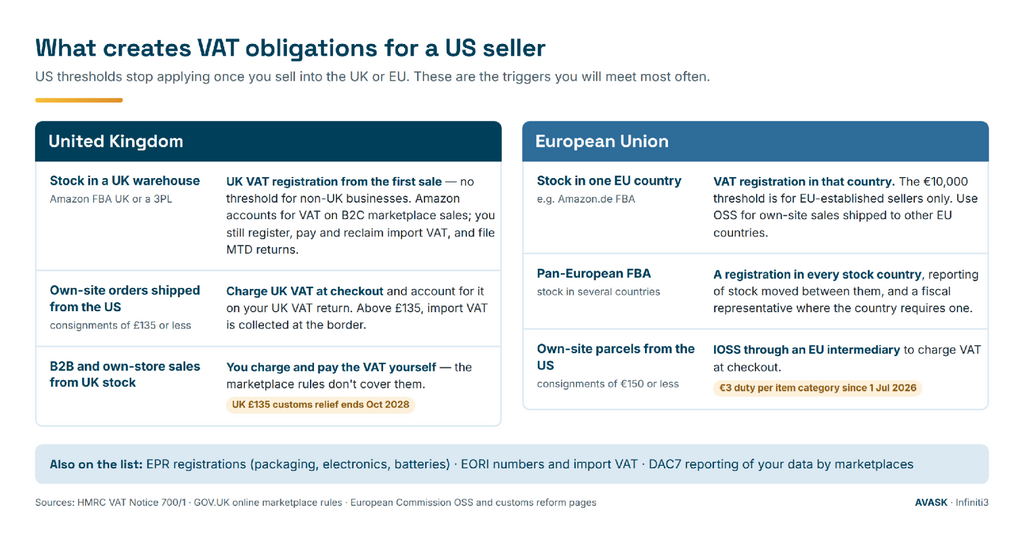
The triggers a US seller meets most often in the UK and EU.
Selling into the UK
The UK has a VAT registration threshold of £90,000, but it only applies to UK-established businesses. HMRC is explicit that the threshold does not apply to non-established businesses: if you make taxable supplies in the UK, for example by selling from UK FBA stock, you register from the first sale.
Online marketplaces change who pays the VAT, not whether you register. Under the UK online marketplace VAT rules, Amazon, eBay and other marketplaces account for VAT on imports of £135 or less and on goods located in the UK that overseas businesses sell. You still need a UK VAT number for the stock you import, to pay and reclaim import VAT, and to report your sales. Anything you sell outside the marketplace, such as orders through your own Shopify store or to business customers, is VAT you charge and pay yourself.
Every UK VAT return is filed through software under Making Tax Digital for VAT, so whichever tool you choose needs an MTD-compatible connection to HMRC. For the step-by-step, see how to register for UK VAT as an overseas seller.
| What Amazon collects for you, and what is still your jobThe marketplace accounts forStill your jobVAT on consumer sales it facilitates for non-UK and non-EU sellers from local stockA VAT registration in every country where your stock sitsVAT on low-value imports sold through the marketplace (£135 or less in the UK; €150 or less in the EU)Import VAT on inbound shipments, and reclaiming itUS sales tax as a marketplace facilitator in every sales-tax stateStock moved between countries, own-website and B2B sales, VAT returns and records, EPR |
Selling into the EU
The EU’s €10,000 threshold for cross-border sales to consumers is only available to sellers established in a member state, according to the European Commission. For a US company, three situations cover most of what you will meet:
- Stock in an EU warehouse. If Amazon or a 3PL stores your goods in a country, you need a VAT registration there. With Amazon’s Pan-European FBA program that can mean several registrations at once, and stock moving between countries has to be reported.
- Cross-border sales from EU stock to EU consumers. The Union One Stop Shop (OSS) lets you declare these in one quarterly return instead of registering in every destination country. It does not replace the registration where your stock is held. Marketplace sales by non-EU sellers are usually the marketplace’s to declare, so OSS matters most for your own-site orders.
- Parcels shipped from the US to EU consumers. For consignments of €150 or less, the Import One Stop Shop (IOSS) lets you charge VAT at checkout; a US company needs an EU-based intermediary to use it. Since 1 July 2026 the EU also charges a temporary €3 customs duty on low-value parcels, per item category, until July 2028.
Some countries also require a fiscal (tax) representative. The UK doesn’t. France, for example, requires one for US companies, and several other EU countries have similar rules. See OSS and IOSS registration for how the schemes work in practice, and the end of duty-free for low-value parcels for the 2026 customs changes.
Beyond VAT: EPR, customs and reporting
- EPR. Packaging, electronics and batteries need extended producer responsibility registrations in countries such as Germany and France, and marketplaces ask for the numbers. Since 12 August 2026, sellers established outside the EU must also appoint an authorized representative. See EPR registration for Amazon sellers in Europe.
- Customs. Importing stock needs an EORI number, customs declarations and import VAT. See UK and EU customs clearance and EORI.
- Reporting. Under DAC7 seller reporting, marketplaces share your sales data with EU tax authorities, so gaps between what Amazon reports and what you file are visible.
- What’s next. The EU’s VAT in the Digital Age (ViDA) reforms add a single VAT registration and a module for moving your own goods between countries from 1 July 2028. That should cut some registrations; it won’t remove the need to file.
What your US sales tax tool does, and what it doesn’t do for VAT
A good US sales tax tool calculates rates, tracks nexus and files state returns. It usually won’t register you for VAT, file returns in each EU country’s format, act as your fiscal representative or answer a letter from the German tax office. That gap, not calculation, is what you are really buying for.
Since the US Supreme Court’s 2018 South Dakota v. Wayfair decision, US tools have been built around economic nexus: watching sales by state, registering you when you cross a threshold and filing returns. They also handle marketplace facilitator laws in every sales-tax state, which make Amazon, Walmart and others collect on your behalf.
| Usually covered by US sales tax software | Usually not covered on the VAT side |
|---|---|
| Rate calculation for every state and local jurisdiction | UK and EU VAT registrations and VAT numbers |
| Economic nexus monitoring and alerts | UK returns filed under Making Tax Digital |
| State registrations | Local VAT returns in each EU country, plus OSS and IOSS |
| Automated state filing and remittance | A fiscal representative or IOSS intermediary |
| Exemption and resale certificates | Ingesting and reconciling Amazon’s VAT Transaction Report |
| Marketplace facilitator reporting | EPR, import VAT and EORI, and tax-office letters in local languages |
Some US tools have stepped back from international tax altogether. TaxJar, for example, no longer offers international calculations to new customers and points them to Stripe Tax. Others calculate VAT but hand registrations and filings to partners.
There is one more thing a US tool rarely sees: the whole picture across channels. If you sell on Amazon and through your own store, marketplace-collected tax and tax you collected yourself have to be reconciled before each return, on both sides of the Atlantic. Our guide to what Shopify collects and what you still owe shows how that works in the US.
| Not sure what your UK or EU launch will trigger?Talk to a specialist who covers both sides. We’ll map the registrations, returns and deadlines for the markets you’re entering. Talk to a compliance specialist → |
Three ways to run sales tax and VAT together
There are three workable setups: one global indirect tax engine that covers both, two specialist providers (one for US sales tax, one for UK and EU VAT), or one compliance partner that registers and files on both sides. The right one depends on your size, your channels and how much of the filing you want to own.
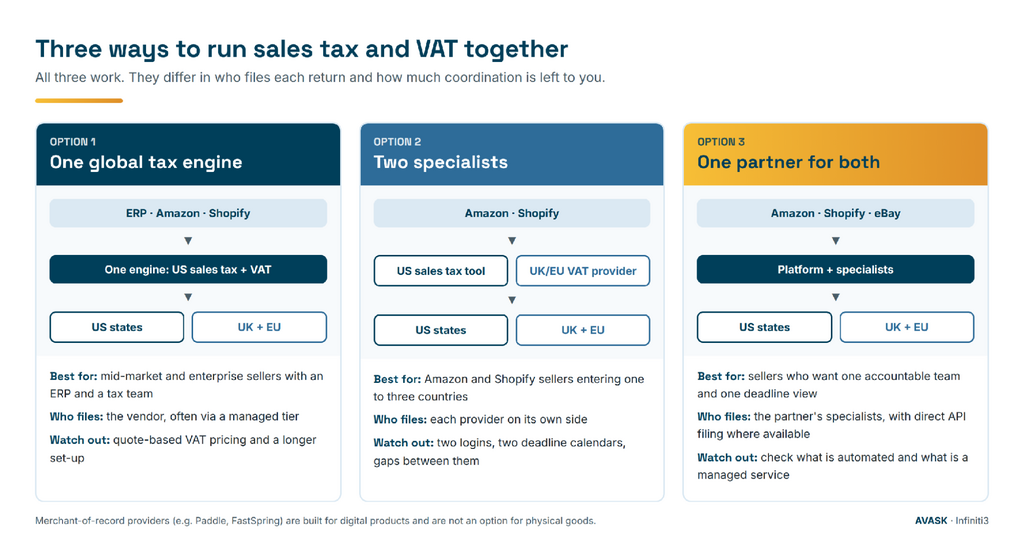
Who files each return is the real difference between the three setups.
Option 1: one global indirect tax engine
Indirect tax compliance software from Avalara, Sovos or Vertex covers US sales tax and VAT under one contract, often with managed filing and fiscal representation as add-ons. It suits companies with an ERP, a tax team and volume in many countries. Expect quote-based VAT pricing and a longer implementation. Global tax compliance software at this level is powerful, but smaller marketplace sellers often pay for coverage they don’t use.
Option 2: two specialists
Keep your US sales tax tool and add a UK and EU VAT provider that registers and files for you. This is the most common setup for Amazon and Shopify sellers because each provider is strong on its own side. The cost is coordination: two logins, two deadline calendars, two sets of data pulled from the same Amazon account, and nobody who owns the whole picture.
Option 3: one compliance partner for both
A single partner runs both regimes, usually as software plus specialists who file for you. You get one deadline view, one data connection to your marketplaces and one team for cross-border tax compliance questions. Check exactly which parts are automated in the platform and which are a managed service, and whether the partner files directly with tax authorities. AVASK works this way through the Infiniti3 compliance platform; Lovat (Lappa) offers a self-service software version.
| Setup | Suits | You manage | Who files | Cost pattern | Main risk |
|---|---|---|---|---|---|
| One global engine | Mid-market and enterprise sellers with an ERP | Integration, tax logic, reviews | The vendor (software or managed tier) | Per state or per country; VAT usually quoted | Paying for enterprise scope; long setup |
| Two specialists | Amazon and Shopify sellers entering one to three countries | Two vendors, reconciliation, deadlines | Each provider on its own side | Two sets of fees | Gaps between the two, e.g. stock moves or own-site sales |
| One partner for both | Sellers who want one accountable team for US and UK/EU | Approvals and data access | The partner’s specialists and platform | One bundled quote | Automated vs managed parts not clear |
| Why merchant of record isn’t the answer for physical goodsMerchant-of-record providers such as Paddle and FastSpring become the seller for tax purposes and handle sales tax and VAT for you, but they are built for software and digital products. Paddle’s own policy excludes physical products, so the model doesn’t fit Amazon FBA or a Shopify store that ships goods. |
Sales tax and VAT compliance software compared (2026)
The best sales tax and VAT compliance software for a US seller of physical goods is the one that files both sides in the countries you actually sell in. Avalara and Sovos cover both at enterprise scale; Kintsugi, Lovat and Stripe Tax offer software routes with different limits; AVASK combines the Infiniti3 platform with specialists who file for you.
| Provider | US sales tax | UK and EU VAT | Who files | Published pricing |
|---|---|---|---|---|
| Avalara | Calculation, nexus, registrations, managed returns | Registrations in 70+ countries; returns; OSS/IOSS (acts as IOSS intermediary); fiscal representation; HMRC-recognized MTD | Avalara (software or managed) | US: $79 per state/month (Avalara Select); VAT on quote |
| Sovos | Managed filing | Filing in 70+ countries; OSS/IOSS intermediary; fiscal representation | Sovos (managed) | Custom |
| Vertex | Calculation and returns | VAT returns in 59 countries; managed VAT service | Vertex software or service | Quote |
| Stripe Tax | Calculation, registration; filing by TaxJar | Calculation; registration and filing through partners (Taxually, Marosa) | Partners | 0.5% per transaction (no-code) or $0.50 (API); Tax Complete from $90/month |
| Kintsugi | Calculation, nexus, registration, filing | UK (MTD) and EU including OSS on the Premium plan | Kintsugi | $75 per US filing or registration; UK/EU on custom plan |
| Anrok | Full US compliance | Registration and filing in many countries; physical goods in early access since 2025 | Anrok | Per market per month ($50–$100 shown on its site) |
| Quaderno | Calculation; filing as a paid add-on | UK and OSS filing as paid add-ons | Optional | Plans from about $24/month plus filing fees |
| Lovat (Lappa) | Auto-submission in 37 states (paid) | VAT, OSS/IOSS, representation services, EPR in 28 countries | You submit, or paid auto-submission | VAT from €35/month |
| Taxually | US product currently unavailable for ecommerce businesses | EU-27 and UK; OSS/IOSS; EPR in Germany, France, Spain | Taxually | Quote |
| AVASK (Infiniti3) | Managed service today (nexus review, registrations, filings); moving into Infiniti3 by end of Q4 2026 | UK and EU registrations; direct API filing in the UK, Germany, Spain, Czech Republic, Poland and IOSS; OSS; fiscal representation; EPR; customs | AVASK specialists with the platform | Self-Serve, Premium and Enterprise tiers; quoted |
| TaxJar (US only) | Calculation, AutoFile (all states except Alaska) | Not for new customers | TaxJar | $39 or $99/month; $50–$55 per extra filing |
| Zamp (US only) | Fully managed | None | Zamp | Quote |
Checked on each vendor’s website on 28 September 2026. Prices and features change often; confirm with the vendor before you sign.
How to read the table. A tick for “VAT” on a pricing page can mean anything from rate calculation to full registration and filing. The “Who files” column is the one that decides your workload. A few notes on fit for a US seller of physical goods:
- Avalara: one vendor across US and UK/EU, including IOSS intermediary and fiscal representation. Watch per-state US pricing (with a three-state minimum on its Core Compliance plan) and quote-only VAT.
- Sovos and Vertex: strong for ERP-led enterprises that want managed VAT; neither lists an Amazon integration.
- Stripe Tax: a good fit for direct-to-consumer stores that check out through Stripe. Amazon sales aren’t Stripe transactions, so they sit outside it, and non-US filing runs through partners at extra cost.
- Kintsugi: transparent US pricing with a path to the UK and EU, but VAT sits on a custom plan.
- Anrok: built for SaaS; physical goods support is newer and Amazon connections are on request.
- Quaderno: low-cost calculation and reports for smaller sellers, with filing as an add-on.
- Lovat (Lappa): broad coverage at low entry prices; by default you check and submit returns yourself.
- Taxually: strong on EU and UK VAT plus EPR, but its US sales tax product isn’t available for ecommerce businesses today.
- AVASK: one team for UK and EU VAT, EPR, customs and US sales tax, with direct filing through Infiniti3 where tax authorities offer APIs. The US side is a managed service until it moves into the platform.
If you only need the VAT side, see our 2026 comparison of VAT compliance software, which reviews ten VAT tools in depth. If you’re moving from a provider that has left the market, such as VAT Services on Amazon (ended 31 October 2024) or Taxdoo (VAT services ended 30 April 2026), here is how switching VAT provider works.
| See Infiniti3 on your own dataConnect a marketplace, see VAT liabilities, filings and deadlines across your markets, and ask how US sales tax fits in. Book a platform demo → See the platform → |
How to choose: 10 questions to ask any provider
Ask who files, where, and what’s included. Rate calculation is table stakes; registrations, direct filing, representation and evidence are where providers differ, and where penalties come from.
- Who files each side? Get it in writing for US states, the UK and every EU country you’ll sell in.
- Which countries are filed directly, and which through a partner? Direct API filing is faster and leaves a cleaner audit trail.
- Are registrations included, and how long do they take? A late VAT number delays your launch or creates back-dated tax.
- Do they provide a fiscal representative or IOSS intermediary where one is required?
- Can they ingest Amazon’s VAT Transaction Report and your Shopify data without manual exports?
- Do they reconcile marketplace-collected tax against tax you collected yourself, in the US and in Europe?
- Is there one view of deadlines for US states and VAT countries?
- What evidence do they keep? Look for filing receipts, proof of payment and invoices stored against each period.
- Who answers tax-office letters, and in which languages?
- What’s the pricing model, and what costs extra? Ask per state, per country and per filing, and whether EPR and customs are included.
Which setup fits your stage?
Match the setup to your footprint. A US-only seller needs a sales tax tool; the first UK or EU stock placement adds VAT registrations; Pan-European FBA or several countries is where one accountable partner pays off.
| 1 | US only, on marketplaces and your own storeA US sales tax tool or managed service covers nexus and filings. Check VAT before you list on Amazon.co.uk or ship to Europe, not after.Setup: US tool or managed service |
| 2 | US plus Amazon.co.uk with UK FBA stockPlan the UK VAT registration before your stock arrives, then MTD returns and an EORI number for imports. Amazon accounts for VAT on consumer sales, but you still file. This is the scenario of a US brand launching on Amazon.co.uk in our VAT software comparison.Setup: Keep the US tool and add a UK VAT provider, or move to one partner |
| 3 | US plus one EU warehouse (for example Amazon.de)Expect a VAT registration in that country, EPR registrations for your product categories, and OSS if you also ship own-site orders from that stock to other EU countries. Our guide to registering for EU VAT for the first time walks through it.Setup: Two specialists or one partner |
| 4 | Pan-European FBA or several EU countriesStock in several countries means several registrations, reporting of stock moves, fiscal representatives where required and EPR in each market. Global VAT compliance at this scale is where one deadline view and one accountable team matter most. See how we support sellers expanding into the UK and EU.Setup: One partner, or an enterprise engine with managed filing |
| 5 | Direct to consumer from a US warehouseFor UK orders of £135 or less you register and charge UK VAT at checkout. For EU orders of €150 or less you use IOSS through an intermediary, and the €3 duty per item category applies. Above those values, import VAT and duty are due at the border.Setup: A checkout tax tool plus a provider that files UK VAT and IOSS |
“We’ve hit sales tax nexus in several states and we’re expanding into Europe. What handles both?”
Separate calculation from compliance. At checkout, Amazon collects the tax on most marketplace sales on both sides of the Atlantic, and your store platform or a tool like Stripe Tax calculates it on your own site. What no checkout tool does is register you, file returns in each state and country, keep the evidence and deal with tax offices. So the real choice is between keeping your US tool and adding a UK and EU provider that files, or moving both sides to one partner with one deadline view. Either works. What fails is assuming the checkout tool covers the filing.
What running both actually costs
Budget by filings, not by software seats. Your cost is roughly the number of US state returns plus the number of VAT returns you file each year, plus registrations, representation and EPR, and the time it takes to reconcile them.
| Pricing model | Published examples (checked 28 September 2026) |
|---|---|
| Per state per month | Avalara Select lists $79 per state per month for US compliance ($69 for Streamlined Sales Tax states). |
| Per filing | Kintsugi and Numeral list $75 per US filing; TaxJar charges $50–$55 per AutoFile filing beyond the credits in its plans. |
| Per country per month | Lovat’s VAT plans start at €35 per month on annual billing. |
| Per transaction | Stripe Tax charges 0.5% per transaction on its no-code plan, where you’re registered. |
| Quote-based | Most enterprise VAT services, including Avalara’s VAT offering, Sovos and Vertex, and managed partners such as AVASK. |
Costs that rarely appear on pricing pages:
- Fiscal representative and IOSS intermediary fees in countries that require them.
- Zero-tax state returns: in many states your marketplace sales count toward your nexus threshold, so you may have to register and file even when Amazon collected everything.
- EPR scheme fees and registrations per country and product category.
- Registration lead times: AVASK currently quotes about 6–10 weeks for UK VAT and 2–3 months for Germany. A late registration delays your launch or creates back-dated liabilities.
- The hours spent reconciling two providers’ data every period.
| Which plan fits your footprint?Answer five quick questions about your markets, turnover and how much support you want, and we’ll recommend a plan. Find the right compliance plan → |
How Infiniti3 handles sales tax and VAT
Infiniti3 is AVASK’s compliance platform. It connects your sales channels, calculates and validates VAT, files directly with tax authorities where APIs exist and keeps the evidence, while AVASK specialists register and file for you. US sales tax is handled today by AVASK’s specialists and moves into the platform by the end of Q4 2026.
- Connect: Amazon, Shopify (through the Infiniti3 app), eBay and 20+ other channels, with marketplace reports pulled in automatically.
- Calculate and validate: VAT and EPR calculation engines with a validation service that catches errors before they reach a return.
- Submit: direct filing through tax-authority APIs in the UK (HMRC), Germany, Spain, the Czech Republic, Poland and for IOSS. AVASK’s team files everywhere else.
- Prove: filing receipts, proof of payment and captured invoices kept against every period.
- People: 420+ specialists in 12 countries and 25 languages handle registrations, fiscal representation where required, EPR and tax-office correspondence.
- US sales tax: nexus review, state registrations and filings by AVASK specialists today. See US sales tax registration and filing.
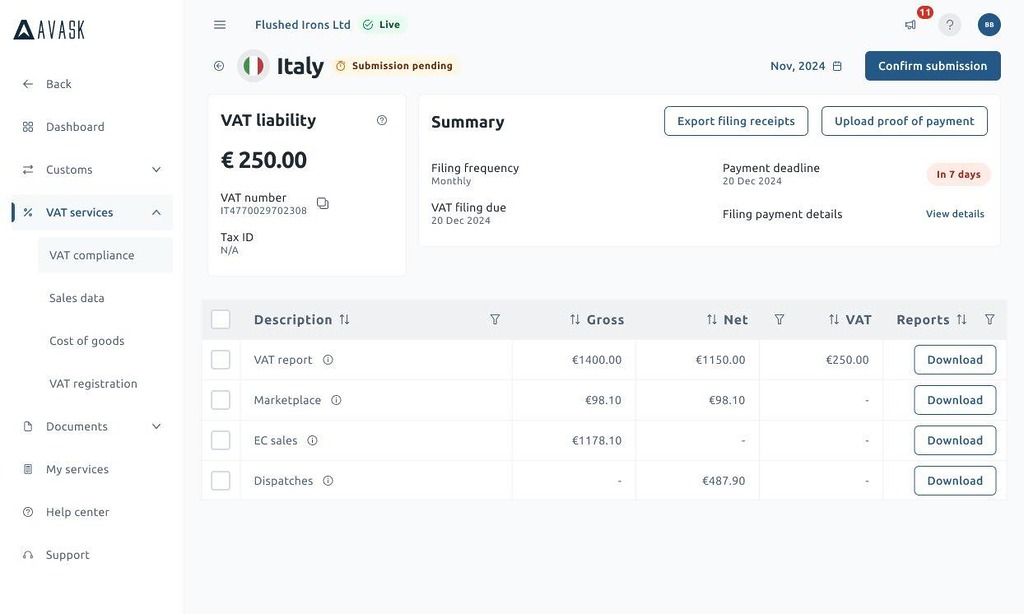
Infiniti3 VAT compliance view: liability, deadlines, filing receipts and proof of payment per country (demo data).
Explore UK and EU VAT registration and filing with AVASK, or see how the platform works.
FAQ
Can one software handle both US sales tax and VAT?
Yes, but coverage varies. Avalara and Sovos cover both at enterprise scale, some software tools cover both through partners or premium plans, and compliance partners such as AVASK handle both with specialists. The deciding question is who registers and files on each side, in each country you sell in.
Does Avalara handle VAT?
Yes. Avalara offers VAT registrations in more than 70 countries, VAT returns (48 countries through its software and 53 through its managed service, per its website), OSS and IOSS filing, including acting as an IOSS intermediary, and fiscal representation through its managed service. VAT pricing is quoted rather than published.
Does TaxJar do VAT?
No, not for new customers. TaxJar focuses on US sales tax and says it does not offer international calculations to new customers, pointing them to Stripe Tax instead. If you use TaxJar for the US, you’ll need a separate provider to register and file UK and EU VAT.
Do US companies need a VAT number?
Only once they have VAT obligations abroad. The US has no VAT, so there is no US VAT number, and an EIN is not one. A US company needs a UK VAT number from its first taxable sale in the UK, and an EU VAT number in each country where it holds stock or must register. You can check EU numbers with the EU VIES VAT number check.
Does Amazon collect VAT for me in the UK and EU?
Often, yes, but you still have work to do. For sellers established outside the UK and EU, Amazon accounts for VAT on most consumer marketplace sales from local stock and on low-value imports. You remain responsible for registering where your stock sits, import VAT, stock movements, own-website and B2B sales, and filing your returns.
Can a US seller use OSS?
Yes, in part. A seller established outside the EU can use the Union OSS to declare cross-border sales of goods shipped from stock inside the EU, and the IOSS, through an EU intermediary, for imports of €150 or less. OSS does not replace the VAT registration where your stock is stored, and the €10,000 threshold only applies to EU-established sellers.
Do I need a fiscal representative?
Not in the UK. In the EU it depends on the country: France, for example, requires a tax representative for US companies, while others don’t. A provider that can act as your fiscal representative where needed saves you finding a separate firm in each country.
What is the best solution for VAT and US sales tax combined?
For most US Amazon and Shopify sellers entering one to three countries, two specialists or one compliance partner works best; enterprise engines suit companies with an ERP and a tax team. Choose the setup where someone is clearly responsible for filing every return on both sides, with one view of deadlines.
Run sales tax and VAT without two sets of blind spots
Selling across the Atlantic means two tax systems with different triggers, returns and evidence. Whichever setup you choose, make sure every return has an owner, every deadline sits in one view, and your marketplace data flows in without spreadsheets.
Adding the UK or EU to your US business?
Get one plan for US sales tax, UK and EU VAT, EPR and customs, from registration to the last return.


