










Table of Contents
ToggleQuick Answer
For busy sellers and decision-makers, here are the core pillars of a successful US-to-EU e-commerce expansion:
- VAT compliance is non-negotiable: Unlike US sales tax, European VAT must often be handled before you import goods, and storing inventory in any EU country immediately triggers a local VAT registration requirement.
- Logistics dictate your tax footprint: Choosing between Amazon’s Pan-EU Fulfilment by Amazon (FBA) network and the European Fulfilment Network (EFN) involves a direct trade-off between faster delivery speeds and additional tax obligations.
- Localization drives advertising success: You cannot simply translate your US PPC campaigns into French, German, or Spanish. True localisation requires native keyword research and an understanding of unique regional consumer behaviours.
- A unified approach wins: Compliance, logistics, and marketing must work together. For instance, your PPC campaigns should only target countries where you have active tax registrations and healthy localised inventory levels.
Challenges and Opportunities of US-to-EU E-Commerce Expansion
Expanding an e-commerce brand from the United States into the European Union is an exciting growth opportunity. The EU represents a massive, affluent consumer market that can drastically increase your revenue. However, achieving sustainable success in Europe requires much more than simply listing your existing US products on Amazon’s European marketplaces.
To thrive, cross-border sellers must navigate an intricate landscape. It demands a clear, interconnected strategy that spans European value-added tax (VAT) compliance, international logistics, and localised performance marketing (PPC). If you lack coordination across these pillars, your expansion can quickly stall due to border delays, tax penalties, or inefficient advertising spend.
In this comprehensive roadmap, AVASK and Pink Panthers break down the essential steps to help US sellers confidently and compliantly enter the EU market, maximise profitability, and build a lasting international brand.
1. Understanding VAT and Compliance in the EU
Before you ship a single inventory box across the Atlantic, your brand must prioritise European tax compliance. For US-based business owners, the European tax system can feel incredibly complex because it differs fundamentally from the US sales tax model.
What is VAT?
Value-Added Tax, universally known as VAT, is a consumption tax assessed on the value added to goods and services. It applies to almost all goods bought and sold for use or consumption in the EU.
While US sales tax is collected only at the final point of sale to the consumer, VAT is collected fractionally at each stage of the supply chain. Ultimately, the tax burden falls on the final consumer, but businesses act as collection agents for European tax authorities.
How VAT Differences Affect You
| Feature | US Sales Tax | European VAT |
|---|---|---|
| Pricing Structure | Added at checkout | Built into price |
| Storing Inventory | Nexus rules vary | Immediate VAT trigger |
| Import Obligations | Seldom applicable | Import VAT due |
Critical Tax Considerations for US Sellers
Navigating European tax laws requires an understanding of several key systems, thresholds, and identifiers:
- EORI Number (Economic Operators Registration and Identification): This is your business’s passport for customs. Before importing physical goods into the EU, you must obtain an EORI number from a European customs authority. It tracks all goods entering or leaving the trading block.
- Local VAT Registration: If you utilise Amazon FBA and store your inventory in a European fulfilment centre (such as a warehouse in Germany, France, or Italy), you are legally required to register for VAT in that specific country immediately. There is no minimum sales threshold for foreign sellers storing local inventory.
- Import VAT and Customs Duties: When your shipment arrives at a European port or airport, you must clear customs. At this point, you will be liable to pay import VAT (ranging from 17% to 25%, depending on the entry country) alongside any applicable customs duties. Fortunately, you can typically reclaim this import VAT later on your regular tax returns if you are properly registered.
- The One-Stop Shop (OSS) Scheme: Introduced to simplify cross-border e-commerce, the OSS scheme allows businesses to declare and pay VAT on all distance sales of goods to consumers across the entire EU via a single, centralised electronic portal. Instead of registering for VAT in every country where you have a customer, you can file a single quarterly OSS return.
The Risks of Non-Compliance
European tax authorities have become incredibly strict, working directly with online marketplaces like Amazon to enforce tax collection. Failing to manage your tax obligations can lead to severe consequences:
- Immediate Account Suspensions: Marketplaces will freeze your seller account if you fail to provide a valid VAT number.
- Customs Seizures: Shipments can be held indefinitely at the border, disrupting your supply chain and causing stockouts.
- Heavy Financial Penalties: Late filings or unpaid taxes quickly accumulate compounding interest and retroactive fines.
Transitioning into compliance early does not just protect your business from legal trouble; it also builds trust with marketplaces, supply chain partners, and your European end-consumers.
2. Structuring Your Logistics for EU Expansion
Once you understand your compliance framework, the next step is to build a scalable, efficient logistics network. Moving freight internationally introduces variables like ocean shipping timelines, customs clearance agents, and localised returns processing.
Choosing Your Amazon Fulfilment Model
If you are expanding primarily via Amazon, you have two main fulfilment structures to evaluate. Each option carries distinct logistics costs and tax compliance requirements:
Option A: The Pan-EU FBA Program
Under the Pan-EU model, you ship your inventory to a central Amazon fulfilment centre in Europe. From there, Amazon automatically distributes your stock across multiple European countries based on anticipated local consumer demand.
- The Pros: Your products qualify for Amazon Prime across Europe, ensuring fast local delivery speeds (often next-day) and maximum buy-box visibility. Your local shipping fees are also optimised.
- The Cons: Because your inventory is physically stored in multiple countries, this model automatically triggers an immediate requirement for individual VAT registrations in every country where your stock is held (such as Germany, France, Italy, Spain, and Poland).
Option B: The European Fulfilment Network (EFN)
The EFN model allows you to store all of your European inventory in one single country (for example, Germany or France). When a customer in a neighbouring country buys your product, Amazon ships it across the border from that central hub.
- The Pros: This approach drastically reduces tax complexity. You only need to register for VAT in the single country where your inventory physically sits, utilising the OSS scheme to handle cross-border sales tax collection.
- The Cons: Cross-border shipping rates are significantly higher than local fulfilment fees, which can erode your profit margins. Additionally, shipping times to the end consumer are longer, which can lower your listing conversion rates.
Integrating Third-Party Logistics (3PLs)
Many mature brands choose to partner with independent 3PL providers in Europe alongside Amazon FBA. Storing bulk cargo in an independent European 3PL allows you to feed inventory into Amazon FBA centres as needed. This protects you against Amazon’s strict storage capacity limits while lowering your overall storage costs.
A well-structured logistics approach ensures smooth cross-border movement, prevents costly warehouse stockouts, and guarantees that your imports remain aligned with local customs laws.
3. Scaling with PPC: Driving Visibility and Sales
With your tax registrations active and your inventory safely checked into European warehouses, your focus must shift to marketing. Pay-Per-Click (PPC) advertising is the primary lever for generating visibility, driving search rank, and capturing market share in competitive European marketplaces.
However, many US brands make the critical mistake of assuming that what works in North America will work flawlessly in Europe. In reality, European consumers have completely different buying habits, search trends, and cultural expectations.
The Pitfalls of Simple Translation vs. True Localisation
If you simply copy your top-performing US keywords and run them through a basic translation tool, your advertising campaigns will likely underperform. True localisation requires native keyword research that reflects how locals actually speak and shop.
- Dialects and Regionalisms: In Germany, the word for a specific product might vary between regions. Similarly, Spanish spoken in Spain uses different terminology and phrasing than Spanish spoken in Mexico or South America.
- Search Intent Variations: A keyword that implies high buying intent in the US might be used purely for informational research in Europe. Working with native speakers ensures you target keywords that actually convert into sales.
Adapting to Fragmented Markets
When advertising in the EU, you are not managing a monolithic market. You are targeting a collection of distinct countries, each requiring a tailored strategy:
- Varying Conversion Rates: Average conversion rates vary by region. For example, German shoppers tend to read product descriptions and technical specifications thoroughly before buying, leading to longer consideration phases.
- Localised Visual Assets: Your product images, infographics, and A+ content must be translated and culturally adapted. If a French shopper sees English text on an instructional image, they are highly likely to click away.
- Regional Budgeting: Allocate your advertising spend dynamically based on geographic performance. Do not treat Europe as a single budget pool; optimise your campaigns by country to maximise your return on advertising spend (ROAS).
4. Bringing It All Together: A Unified Expansion Strategy
True success in the European Union comes from aligning compliance, logistics, and marketing into one cohesive corporate strategy. These three core business functions should never operate in isolation.
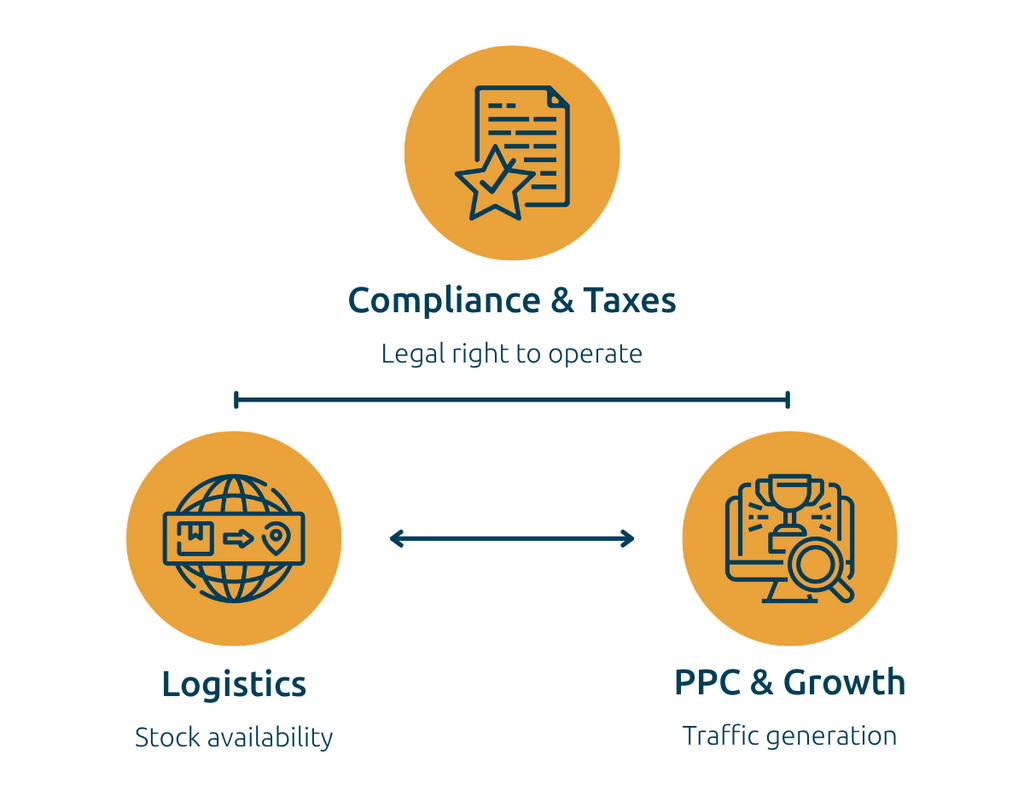
Consider how deeply these dependencies run:
- Compliance enables Logistics: You cannot clear customs or move inventory into European fulfilment centres without an active EORI number and valid VAT registrations.
- Logistics fuels Marketing: Your PPC campaigns should spend money only on advertising products that are actively in stock in local warehouses. If you run out of stock due to shipping delays, your search rankings will drop, wasting the hard-earned marketing momentum you’ve built.
- Marketing directs Compliance: Your long-term sales data and PPC trends will tell you which European countries have the highest demand. This data reveals exactly where you should expand your physical inventory footprint next, guiding your future VAT registration roadmaps.
When these elements work together seamlessly, they create a highly efficient foundation for long-term growth across the continent.
Partner Spotlight: Pink Panthers
Pink Panthers is a specialised Amazon growth agency focused on helping brands scale across international marketplaces. With deep expertise in European expansion, they support sellers in optimising listings, managing PPC campaigns, and driving sustainable growth across multiple regions.
| Exclusive Incentives for AVASK Clients Free Company Audit: A comprehensive suitability assessment tailored for US brands looking to enter the Amazon EU ecosystem. This audit identifies potential roadblocks and outlines your optimal path to market entry. Free PPC & Account Audit (Valued at €300): A detailed performance review of your current advertising structures, designed to uncover hidden growth opportunities, eliminate wasted ad spend, and maximise your initial European ROAS. Claim these exclusive incentives! |
Entering the European market doesn’t have to be complex. With the right guidance, you can navigate VAT compliance, streamline logistics, and build high-performing PPC campaigns with ease. Your success in Europe starts here!