











Table of Contents
Toggle


QUICK ANSWER
Your VAT return and your VAT payment are both due one calendar month and 7 days after the end of your VAT accounting period. If your quarter ends 30 September 2026, both are due by 7 November 2026. The deadline does not move if it falls on a weekend or a bank holiday — your payment must have cleared HMRC’s account by that date regardless. Direct Debit is the only exception: HMRC collects 3 working days after the deadline.
Most guides stop at the one-month-and-seven-days rule. That rule is correct, but it is not the part that catches businesses out.
What catches businesses out is the gap between sending a payment and HMRC receiving it, a deadline that lands on a Saturday and does not move, or a first VAT period that turns out not to be three months long. And if you sell in more than one country, the problem multiplies: every market runs its own calendar.
This guide covers the rules, the 2026/27 dates for all three HMRC stagger groups, how long each payment method actually takes to clear, and what happens if you miss the date.
| Would rather not track this yourself? AVASK prepares and files VAT returns for thousands of sellers across the UK and EU — on time, in every market.See VAT registration and filing · Talk to a compliance expert |
When is your VAT return due?
The deadline for submitting your VAT return online is one calendar month and 7 days after the end of your accounting period. That same date is also the deadline for paying HMRC.
There is no separate, later payment date. Filing early does not extend your payment window. Both obligations land on the same day.
Worked example. Your VAT quarter runs 1 July to 30 September 2026. Add one calendar month — 30 October. Add 7 days — 7 November 2026. Your return must be submitted and your payment must have reached HMRC by that date.
You must file even if you have nothing to declare. A nil return is still a return, and it still has a deadline.
Your exact dates are shown in your VAT online account . Check them rather than assuming — particularly for your first return, which is covered below.
VAT quarters and stagger groups explained
Most businesses file quarterly. But UK VAT quarters do not all run to the calendar year, which is why two businesses can both file quarterly and never share a deadline.
When you register, HMRC assigns you one of three stagger groups:
| Stagger | Quarters end in |
|---|---|
| Stagger 1 | March · June · September · December |
| Stagger 2 | April · July · October · January |
| Stagger 3 | May · August · November · February |
VAT quarter dates and deadlines: 2026/27
Stagger 1 — quarters ending March, June, September, December
| Period ends | Return and payment due |
|---|---|
| 30 June 2026 | Friday 7 August 2026 |
| 30 September 2026 | Saturday 7 November 2026 |
| 31 December 2026 | Sunday 7 February 2027 |
| 31 March 2027 | Friday 7 May 2027 |
Stagger 2 — quarters ending April, July, October, January
| Period ends | Return and payment due |
|---|---|
| 31 July 2026 | Monday 7 September 2026 |
| 31 October 2026 | Monday 7 December 2026 |
| 31 January 2027 | Sunday 7 March 2027 |
| 30 April 2027 | Monday 7 June 2027 |
Stagger 3 — quarters ending May, August, November, February
| Period ends | Return and payment due |
|---|---|
| 31 August 2026 | Wednesday 7 October 2026 |
| 30 November 2026 | Thursday 7 January 2027 |
| 28 February 2027 | Wednesday 7 April 2027 |
| 31 May 2027 | Wednesday 7 July 2027 |
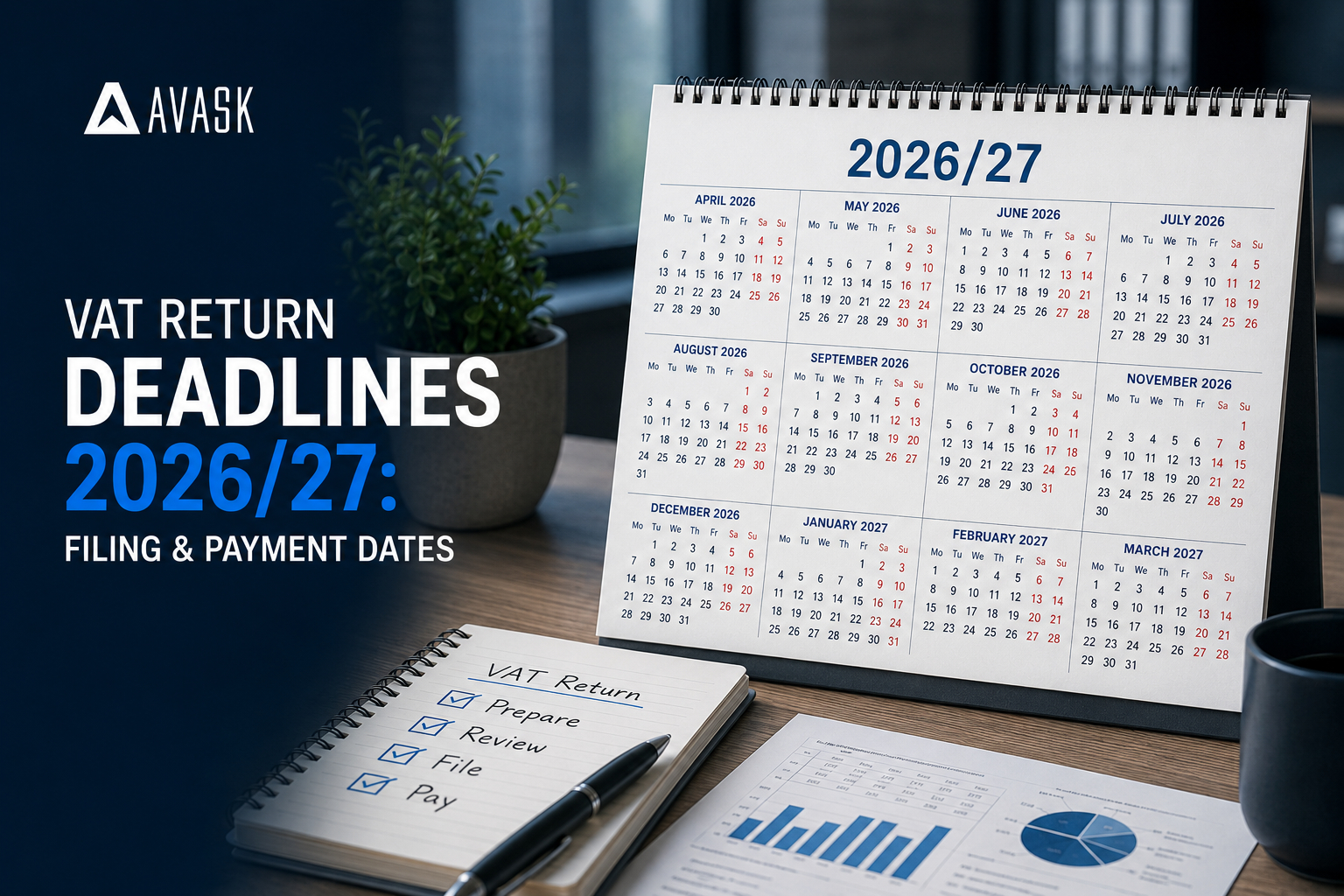
Three of those deadlines fall at a weekend: 7 November 2026, 7 February 2027 and 7 March 2027. None of them shift. Mark them now.
Can you change your VAT quarters?
Yes. If your stagger group sits awkwardly against your financial year or your busiest trading period, you can apply to HMRC to change it. You can also change your filing frequency — from quarterly to monthly, for example — subject to HMRC agreeing.
It is a straightforward application, and worth doing once rather than fighting the wrong dates for years.
| Never chase a VAT deadline againAVASK prepares and submits VAT returns for thousands of sellers across the UK and EU — accurately, and on time, in every market you sell in. Explore VAT registration and filing → avask.com/vat/ |
Monthly, quarterly and annual VAT returns
Quarterly is the default, but it is not the only option.
Monthly returns. If you are regularly in a repayment position — common if you sell zero-rated goods or import heavily — you can apply to file monthly to get refunds faster. HMRC may also place a business on monthly filing. The deadline formula is identical: one calendar month and 7 days after each month end.
Annual Accounting Scheme. If your estimated VAT taxable turnover is £1.35 million or less, you can apply to file one return a year instead of four. The rules are different, so read them carefully:
- Your return and balancing payment are due 2 months after the end of your accounting period — not one month and 7 days
- You make advance payments through the year: nine monthly instalments at 10% of your estimated bill, or three quarterly instalments at 25%
- You must leave the scheme once your turnover exceeds £1.6 million at your year end
- HMRC must approve your entry before you start
Payments on Account. If your annual VAT liability reaches £2.3 million, HMRC puts you into the Payments on Account regime automatically. You make interim payments at the end of the second and third month of each quarter, then a balancing payment with the return. All of it must be electronic, with cleared funds by close of business on the due date.
One point that causes persistent confusion: the Flat Rate Scheme and the Cash Accounting Scheme change how your VAT is calculated. They do not change when it is due. Same deadline.
When is your first VAT return due?
Your first VAT period is very often not three months long.
HMRC sets your first period to run from your effective date of registration to the end of your first stagger period. That can be anything from a few weeks to five months. The one-month-and-7-days rule then applies to whatever that period end turns out to be.
This is the single most common reason a newly registered business misses its first deadline: it assumes a quarter, counts three months from registration, and gets the date wrong.
Check your VAT registration certificate or your VAT online account for the actual period end. If you have just started this process, our guide on how to register for VAT in the UK walks through what to expect, and the £90,000 VAT registration threshold explains when registration becomes mandatory. Not sure it applies to you yet? Start with whether you need to register for VAT .
VAT payment dates: when the money must actually reach HMRC
Here is where most avoidable late payments happen.
The deadline is not when you instruct the payment. It is when cleared funds arrive in HMRC’s account. A Bacs transfer sent on the 6th does not arrive on the 7th.
| Payment method | How long it takes to reach HMRC |
|---|---|
| Direct Debit | Collected automatically 3 working days after the deadline |
| Faster Payments / online banking | Same or next day, including weekends and bank holidays |
| CHAPS | Same working day, if sent within your bank’s cut-off |
| Bacs | 3 working days |
| Standing order (Annual Accounting and POA only) | 3 working days |
| Debit or corporate credit card | Accepted on the date you pay, including weekends |
Two things worth knowing:
Direct Debit is the only built-in breathing room. HMRC collects 3 working days after your payment deadline. But the mandate must be set up at least 3 working days before you submit your return, or the first payment will not be taken. And if you file late, HMRC simply collects 3 working days after you filed — it does not undo the late submission.
You cannot pay by personal credit card. Corporate cards work but carry a non-refundable fee. Personal debit cards are free.
Always use your 9-digit VAT registration number as the payment reference, with no spaces.
HMRC’s own VAT payment deadline calculator will work out how much time to allow — though note it does not cover businesses on Payments on Account or the Annual Accounting Scheme.
What if the deadline falls on a weekend or bank holiday?
It does not move.
This is worth stating plainly, because a lot of published advice gets it wrong in both directions. HMRC’s position is unambiguous: you must submit your return and ensure your payment reaches HMRC on or before the deadline, even if it falls on a weekend or a bank holiday.
In practice that means working backwards. If your deadline is Saturday 7 November 2026 and you pay by Bacs, your payment needs to leave your account by Tuesday 3 November to clear in time. Faster Payments will still go through at a weekend. Bacs will not.
Filing through Making Tax Digital
Paper VAT returns are gone. Every VAT-registered business must keep digital records and submit returns through MTD-compatible software, with digital links between the systems that hold your data.
That has a practical consequence for deadlines: you cannot file at all unless your software connection to HMRC is working. Discovering an authentication problem on the 7th is a bad day.
It also means the quality of your underlying records determines whether you can hit the deadline comfortably or not. Returns are built from invoices — our guide to VAT invoice requirements covers what those need to contain. If you import goods, postponed VAT accounting affects what you declare on the return itself.
What happens if you miss a VAT return deadline?
Late filing and late payment are penalised separately.
Late filing works on a points system. Each late return earns one penalty point. Once you hit your threshold you get a £200 penalty, and a further £200 for every late return after that. The threshold depends on how often you file: 4 points for quarterly filers, 5 for monthly, 2 for annual.
Late payment attracts late payment penalties and interest, with interest running from the due date until the balance is cleared.
Points also do not disappear on their own — they clear only after a qualifying period of filing everything on time with no outstanding returns.
There is a longer-term cost as well. A pattern of late filing raises your risk profile with HMRC and makes a VAT audit more likely.
| Full breakdown coming: our detailed guide to VAT penalties, the points system and late payment charges covers the thresholds, the appeal process and how to get points removed. |
What to do if you can’t pay on time
File the return anyway.
Filing and paying are penalised separately, so submitting on time limits the damage even when the money is not there. Missing both is strictly worse than missing one.
Then contact HMRC — ideally before the deadline, not after. A Time to Pay arrangement lets you spread the balance over an agreed schedule. HMRC is considerably more receptive to businesses that approach them early.
VAT deadlines when you sell in more than one country
Everything above describes one VAT registration in one country. Most of the sellers we work with have several.
If you hold VAT registrations in the UK, Germany, France, Italy and Spain, you are not tracking one deadline. You are tracking five sets of rules, five filing frequencies and five calendars — and a missed date in any one of them triggers penalties in that jurisdiction, regardless of how clean your record is everywhere else.
A few specifics worth flagging:
OSS returns run on their own calendar. If you use the One Stop Shop for EU distance sales, that return does not follow UK VAT dates. It is a separate quarterly obligation with its own deadline, submitted through the member state where you are registered. Our guide to OSS and IOSS covers how the schemes work.
EU member states set their own frequencies. Monthly filing is standard in several markets where UK businesses would file quarterly, and some countries require additional periodic filings on top of the VAT return.
Non-UK businesses lose the Direct Debit safety net. If you have no UK establishment and pay HMRC from an overseas bank account, you cannot use Direct Debit at all. That removes the 3-working-day cushion entirely. Overseas payments go by CHAPS, and HMRC expects them in sterling — pay in another currency and your bank may charge you for it. For an overseas seller, the effective deadline is meaningfully earlier than the printed one.
That last point rarely appears in UK deadline guides, because most are written for UK-domiciled businesses. If you are selling into the UK and EU from outside, it is the detail most likely to cost you.
| Every deadline. Every market. One dashboard. AVASK’s compliance platform monitors your VAT status, filing deadlines and regulatory changes across every market you sell in — with 420+ specialists preparing and submitting the returns behind it. See the platform → Talk to a compliance expert → |
Table of Contents
ToggleFrequently asked questions
When is my VAT return due?
One calendar month and 7 days after the end of your VAT accounting period. For a quarter ending 30 September 2026, that is 7 November 2026.
When is my VAT payment due?
The same date as the return. There is no separate payment deadline.
How long after the VAT return is payment due?
It is not due after the return — it is due at the same time. Cleared funds must reach HMRC by the same date the return is submitted by. The only exception is Direct Debit, which HMRC collects 3 working days later.
What are the VAT quarters?
HMRC assigns one of three stagger groups: quarters ending March/June/September/December, April/July/October/January, or May/August/November/February.
When is my first VAT return due?
Your first period is usually not a full quarter — it runs from your registration date to the end of your first stagger period. Check your VAT registration certificate for the exact period end, then add one month and 7 days.
Do I still have to file if I have no VAT to pay?
Yes. A nil return is required and carries the same deadline.
What happens if I miss the deadline?
Late filing earns a penalty point; £200 is charged once you reach your threshold (4 points for quarterly filers). Late payment attracts penalties plus interest from the due date.
Can I change my VAT quarters?
Yes — you can apply to HMRC to move to a different stagger group, or to change your filing frequency.
Does the deadline move if it falls on a weekend?
No. Your return and cleared payment must reach HMRC on or before the date, even at a weekend or bank holiday.
How do I find my exact VAT deadline?
Sign in to your VAT online account. It shows when each return is due and when payment must clear.
VAT filing, fully managed
Registration, preparation, submission and payment deadlines across the UK, EU and beyond — handled end to end by AVASK’s compliance specialists and tracked in one platform.
Winding a registration down instead? See how to deregister for VAT — the final return has its own deadline.


