







Table of Contents
Toggle


QUICK ANSWER
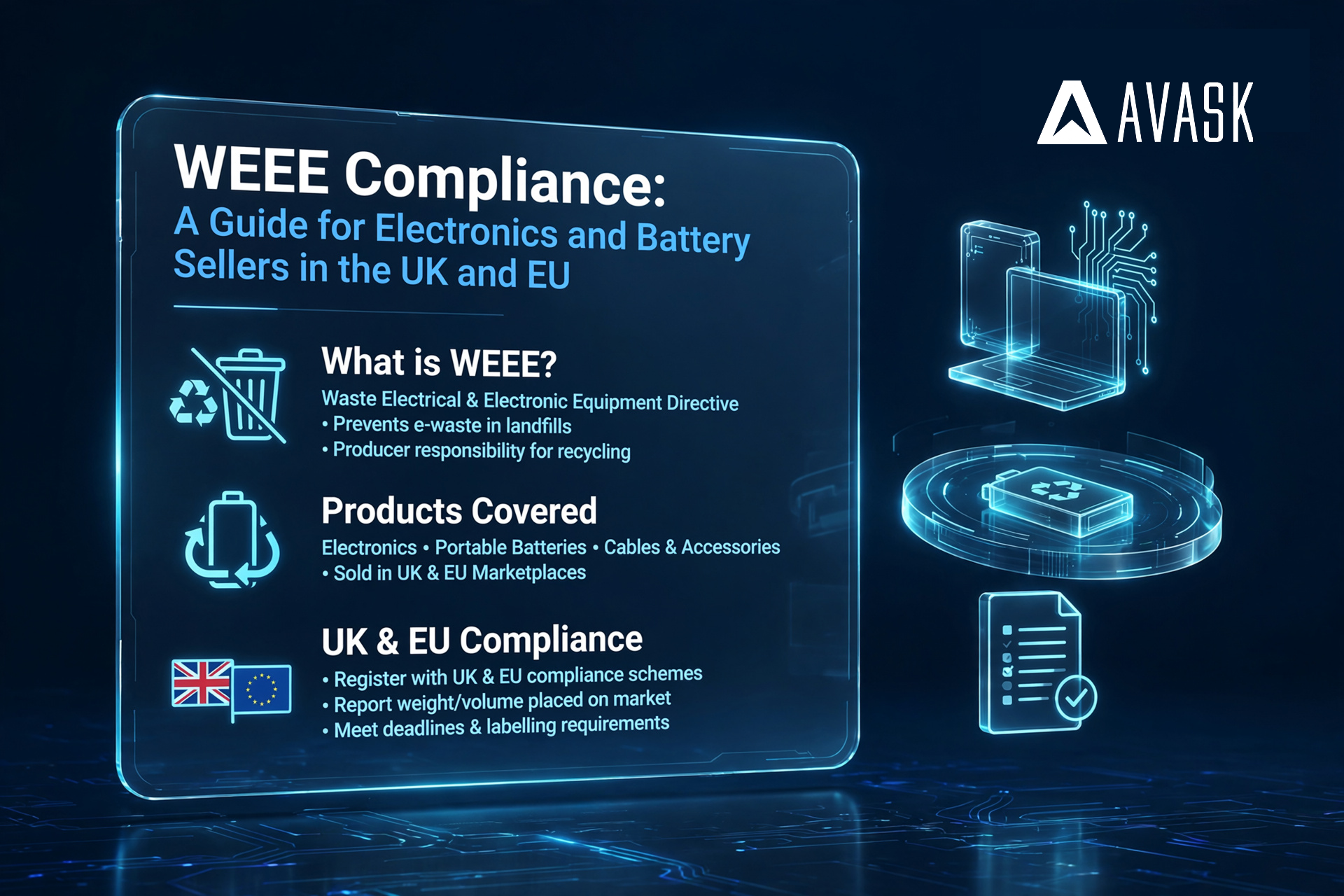
WEEE compliance means meeting your legal duties as a ‘producer’ of electrical and electronic equipment (EEE) under the UK WEEE Regulations 2013 or the EU WEEE Directive (2012/19/EU). In practice you register in each country where you sell, report what you place on the market, finance recycling, and mark products with the crossed-out wheeled bin.
KEY FACTS
- UK: under 5 tonnes of EEE a year, register directly as a small producer; at 5 tonnes or more, join a producer compliance scheme.
- UK marketplaces: since 12 August 2025, online marketplaces are the producer for EEE sold to UK households by non-UK sellers.
- EU: registration is national — one per country, usually through a local authorised representative if you are not established there.
- Batteries: a product with a battery inside needs a separate battery registration as well.
If you sell anything with a plug, a battery or a charging cable into the UK or the EU, WEEE compliance is not optional. The rules decide who pays to collect and recycle electronics at the end of their life, and the answer is usually the business that first put them on the market.
For online sellers the hard part isn’t the principle. It’s working out which of your sales channels makes you the ‘producer’, in which countries, and what has changed recently. The UK rewrote part of its rules in August 2025, so online marketplaces now carry the obligation for many overseas sellers. Germany, meanwhile, won’t let a non-German seller register at all without a local representative — and Amazon checks.
This guide covers the WEEE regulations in the UK and the EU from a seller’s point of view: whether your products are in scope, who counts as a producer, how registration works in each market, where batteries and packaging add further registrations, and what it all costs. If you are expanding into the UK and EU from the US, start with the role test — it will tell you which sections apply to you.
Table of Contents
ToggleWhat WEEE compliance means
WEEE stands for Waste Electrical and Electronic Equipment. Its counterpart, EEE, is electrical and electronic equipment: anything that depends on electric currents or electromagnetic fields to work properly, designed for use at up to 1,000 volts AC or 1,500 volts DC. Put simply, if a product needs mains power, a battery or solar power to do its job, it is almost certainly EEE — and it becomes WEEE when someone throws it away.
WEEE compliance is extended producer responsibility (EPR) for electronics. The business that places the product on the market — the producer — finances the collection, treatment, recovery and environmentally sound disposal of that equipment once it becomes waste. It is one of three EPR waste streams most electronics sellers run into, alongside batteries and packaging. For the wider picture across all three, see our guide to EPR compliance across Europe.
Is WEEE a legal requirement? Yes. In the UK it is a legal duty under the WEEE Regulations 2013 (as amended); in the EU it is a legal duty under each country’s national law implementing the WEEE Directive. For online sellers, the first sign of non-compliance is usually not a letter from a regulator but a blocked listing.
WEEE regulations: the UK and EU rules at a glance
The UK and the EU started from the same directive, but since Brexit they have drifted apart. The table below summarises the WEEE regulations that apply in each.
| United Kingdom | European Union | |
|---|---|---|
| Core law | The Waste Electrical and Electronic Equipment Regulations 2013 (SI 2013/3113), amended in 2025 | WEEE Directive (2012/19/EU), written into national law by each member state (e.g. ElektroG in Germany) |
| Who runs it | Environment Agency, SEPA, Natural Resources Wales, Northern Ireland Environment Agency | A national register or authority in each country (e.g. stiftung ear in Germany) |
| Registration | One UK registration; the route depends on tonnage | A separate registration in every country you sell into |
| Threshold | Under 5 tonnes a year: small producer, register directly. 5 tonnes or more: join a producer compliance scheme | No EU-wide threshold — national rules apply |
| Sellers based abroad | Join a compliance scheme or appoint a UK-established authorised representative | Appoint an authorised representative in each country where you are not established |
| Online marketplaces | The marketplace is the producer for EEE sold to private households by non-UK sellers (since 12 August 2025); marking stays with the seller | The seller stays the producer. Marketplaces must check registration (Germany, since 1 July 2023); in France and Spain, Amazon enrols sellers without valid numbers in Pay on Behalf |
| Categories | 15 broad categories | 6 categories (open scope since 15 August 2018) |
| Marking | Crossed-out wheeled bin, date mark, producer identification | Crossed-out wheeled bin and bar; Germany also requires the registration number on offers and invoices |
WEEE regulations summary. Sources: GOV.UK, legislation.gov.uk, European Commission, stiftung ear. Checked September 2026.
Does WEEE apply to your products?
Both regimes have an ‘open scope’: all EEE is covered unless it falls under a specific exclusion. The safest working rule is to assume a product is in scope until you have checked it against the exclusions.
The UK groups EEE into 15 broad categories — including large and small household appliances, IT and telecoms, consumer equipment, lighting, electrical tools, toys and leisure equipment, medical devices, monitoring and control instruments, display equipment, cooling appliances, LED light sources, solar panels and, since 2025, a separate category for vapes (category 7.1). The EU uses six: temperature exchange equipment, screens over 100 cm², lamps, large equipment (any side over 50 cm), small equipment, and small IT and telecoms equipment. Your reports must use the categories of the country you are reporting in.
Ecommerce products that are often missed
| Product | In scope? | Watch out for |
|---|---|---|
| Power banks and chargers | Yes | Report the battery weight separately under battery rules |
| HDMI and USB cables, memory cards, USB sticks | Yes | Accessories sold with a product are reported with that product |
| LED strips, LED bulbs and smart lamps | Yes | Lamps sit in their own category |
| Heated jackets, clothing with sensors or speakers | Yes, where electricity is a fundamental feature | Often filed as textiles by mistake |
| Toys with lights, sound or motors | Yes | Batteries add a second registration |
| E-bikes and e-scooters | Usually, unless type-approved | Traction batteries have their own rules |
| Vapes and e-cigarettes | Yes | The UK now has a separate category |
| Electronics built permanently into a car or boat | No | Excluded as part of equipment outside scope |
Examples drawn from the UK Environment Agency’s EEE scope guidance. Always check your specific product.
The main exclusions are narrow: military equipment, equipment designed to be installed in another product that is itself out of scope (such as a built-in car sat nav), filament bulbs other than LED, equipment for space, large-scale stationary industrial tools and fixed installations, most means of transport, professional off-road machinery, R&D-only equipment, and implantable or infective medical devices.
You also need to decide whether each product is for households (B2C) or businesses (B2B). Dual-use products — business equipment that could just as easily be used at home — count as household EEE — and household EEE is what the collection targets are built on. WEEE covers only the end of a product’s life; before it goes on sale you also need to meet product safety requirements for electronics.
Who is a ‘producer’? The WEEE role test
Almost every WEEE obligation hangs on one question: are you the producer? It is not only the manufacturer. Under UK rules a producer is a business that manufactures and sells EEE under its own brand, rebrands someone else’s product, imports EEE commercially, or is based abroad and sells EEE directly to UK end users by distance selling. Since August 2025 the list also includes online marketplaces that place EEE from non-UK sellers on the UK market. EU countries use broadly the same logic. If you are the importer of record, your WEEE duties sit alongside your import compliance.
Find your situation below. One business is often several of these at once — a US brand selling on Amazon.co.uk and through its own Shopify store is in two rows for the UK alone.
| Your situation | UK | EU |
|---|---|---|
| You make or brand the product and have a business in that market | You are the producer. Register as a small producer or through a scheme | You are the producer in that country. Register with its national register |
| You import EEE into the market to resell | You are the producer | You are the producer |
| You are based abroad and sell to consumers on Amazon or another online marketplace | The marketplace is the producer for those household sales (since 12 August 2025). Marking stays with you | You stay the producer. The marketplace checks your registration — in France and Spain, Amazon can enrol you in Pay on Behalf |
| You are based abroad and sell to consumers through your own website | You are the producer as a distance seller. Join a scheme or appoint a UK-established authorised representative | You are the producer in each destination country. Appoint an authorised representative there |
| You sell only to businesses (B2B) | Still a producer — including B2B sales made through a marketplace. Different financing rules apply to business WEEE | Still a producer; business equipment is usually registered and reported too |
| You resell other brands’ products bought locally | A distributor: take-back duties apply; ask suppliers for their producer registration number | A distributor: take-back duties vary by country; in Germany you must not sell equipment from unregistered producers |
| Not sure which role you are in each market?AVASK’s EPR team maps your products, channels and countries, then handles the registrations and authorised representation you actually need. See our WEEE registration and authorised representative services. Get your WEEE registrations handled → Speak to an EPR specialist → |
WEEE compliance in the UK
WEEE compliance in the UK is governed by the WEEE Regulations 2013, as amended by the Waste Electrical and Electronic Equipment (Amendment, etc.) Regulations 2025, which took effect on 12 August 2025. The GOV.UK guidance on the WEEE Regulations is published jointly by the Office for Product Safety and Standards and Defra. UK-based producers register with the environmental regulator for the part of the UK where they are established — the Environment Agency, SEPA, Natural Resources Wales or the Northern Ireland Environment Agency. Overseas producers act through a compliance scheme or a UK-established authorised representative.
Small producers and larger producers: the 5-tonne rule
How you register depends on how much EEE you place on the UK market in a calendar year (the ‘compliance year’):
- Under 5 tonnes: you can register directly with your regulator as a small producer. Registration is annual — by 31 January, or within 28 days of first placing EEE on the market — and you report the previous year’s tonnage by category, split between household and business. Small producers pay an annual registration charge but are not allocated a share of the household collection target (obligations for business WEEE can still apply).
- 5 tonnes or more: you must join a producer compliance scheme (PCS). The scheme registers you, reports your data and finances your share of household WEEE collection, calculated from your market share by weight in each category. Schemes are joined by 15 November for the following year.
- Crossing the line mid-year: if you pass 5 tonnes while registered as a small producer, you must tell your regulator and join a scheme within 28 days.
Whichever route you use, you must also report the weight of any batteries in your EEE separately under the battery regulations, make information on reuse and treatment available within a year of placing new EEE on the market, give your producer registration number to the distributors you supply, and keep records for at least four years.
Selling on Amazon.co.uk from outside the UK
This is the change many overseas sellers have missed. Since 12 August 2025, operators of online marketplaces are producers for EEE placed on the UK market by non-UK sellers through their platforms. The marketplace registers, reports and finances the WEEE obligation for those household sales — mirroring what already happened with UK packaging EPR.
Amazon applies this using the registered business address in Seller Central. If that address is outside the UK, you are automatically enrolled in Amazon’s EPR Pay on Behalf service for each applicable category: Amazon calculates and pays the eco-fees on your Amazon.co.uk sales, debits them from your selling account and adds an annual service fee of GBP 20 per EPR category. We cover the detail in our analysis of Amazon’s EPR Pay on Behalf policy.
Three things the marketplace rule does not change. It only covers sales to private households — if you sell to business customers through a marketplace, you are still the producer for those sales. It does not cover EEE you sell to UK customers through your own website (see below). And marking stays with you: the 2025 amendment exempts marketplaces from the marking requirements and applies them to the non-UK seller instead, so your products must still carry the crossed-out wheeled bin and date mark. Pay on Behalf is also not automatically the cheapest option — it is worth checking whether Pay on Behalf makes sense for your business.
Selling from outside the UK through your own website
If your business is established outside the UK and you sell EEE directly to UK customers — through Shopify, your own site, mail order or phone — you are a producer as a distance seller. You need a UK route for your obligations: joining a producer compliance scheme, or appointing a UK-established authorised representative to meet them on your behalf. If your volumes are under 5 tonnes, your authorised representative can register you as a small producer.
If your business is established in the UK
A UK-established seller is the producer for the EEE it places on the UK market, whichever channel it sells through — the marketplace rule does not apply. Register as a small producer or join a scheme depending on your tonnage. If you are setting up a UK entity for UK VAT reasons, plan WEEE registration at the same time.
Retailer and distributor take-back duties
If you sell EEE to UK consumers you are also a distributor, and distributors have separate duties. You must offer free take-back of old equipment when a customer buys a like-for-like replacement — whether you sell in store, online or by mail order — give customers written information about the service, and keep records of WEEE taken back for at least four years. Retailers with more than 400 m² of EEE sales area must also accept small items (under 25 cm) free of charge without a purchase. If you only sell online, or sell less than £100,000 of EEE a year, you can join the Distributor Take Back Scheme instead of running your own take-back service — you must still publish the customer information on your website. Packaging is a separate regime again — see UK EPR for packaging.
A separate category for vapes
The 2025 amendment moved vapes, e-cigarettes and heated tobacco devices out of the toys, leisure and sports category into a category of their own (category 7.1), so that vape producers finance the higher cost of collecting and treating them. Disposable vapes have been banned from sale in the UK since 1 June 2025; refillable products remain on sale and in scope. Retailers that sell vapes must take back used vapes themselves — the Distributor Take Back Scheme is not an option for them.
| SELLING INTO THE UK FROM THE US OR EU?We’ll confirm what Amazon’s Pay on Behalf covers for you, set up your own UK registration where it doesn’t, and keep your reporting on schedule. Need only one or two registrations? Start with self-serve EPR registration. |
WEEE compliance in the EU
In the EU the framework is the WEEE Directive (2012/19/EU), the 2012 recast of the original 2002 directive (2002/96/EC). Since 15 August 2018 it has had an open scope, with all EEE grouped into six categories. But a directive is not a single law: each member state writes it into national law and runs its own producer register, fees and reporting calendar.
One directive, a separate registration in every country
There is no EU-wide WEEE number. If you sell into Germany, France and Spain, you need three registrations, three sets of reports and three sets of fees — and a product category in one country may be defined slightly differently in the next. The European Commission has pushed for harmonised registration and reporting formats, but the national systems remain separate.
When you need an authorised representative
A producer that sells by distance selling into a member state where it is not established must appoint an authorised representative in that country to take on its producer obligations. For a US or UK business selling into the EU, that usually means one authorised representative per country. The European Commission’s Your Europe portal summarises the rule.
In December 2025 the European Commission proposed suspending this requirement until 2035 for producers established in the EU. The proposal is still going through the legislative process, and it would not help US or UK sellers: producers based outside the EU would still need an authorised representative, or whatever alternative each member state requires.
AVASK provides WEEE registration and authorised representative services across the markets we cover. [REVIEW #7]
Germany: stiftung ear and ElektroG
Germany is where most sellers first run into WEEE, because enforcement is direct and marketplace-led:
- A company based outside Germany cannot register with stiftung ear itself. It must mandate a German authorised representative, which then takes over its legal producer obligations. The mandate must be in writing, in German, for at least three months, and you can have only one authorised representative for all your brands (see stiftung ear’s guide for foreign companies).
- Once registered, you receive a WEEE registration number (WEEE-Reg.-Nr. DE), which you must show when you offer EEE for sale and on your invoices.
- Since 1 July 2023, online marketplaces and fulfilment service providers may only serve producers that are properly registered — which is why Amazon validates your WEEE number against the register.
- Producers of household (B2C) equipment must also provide an insolvency-proof guarantee covering future disposal costs.
- Applications are processed in the order received. In AVASK’s experience, WEEE registration in Germany takes 14–16 weeks — the longest of any market we cover.
- AVASK Deutschland GmbH is on stiftung ear’s published list of admitted ElektroG authorised representatives.
Products with batteries need a separate battery registration in Germany too — see Germany’s battery registration rules. If you are registering for WEEE in Germany, you will usually need VAT in Germany as well.
France
France runs WEEE through approved producer responsibility organisations (eco-organisations). Producers join one and receive a unique identification number (IDU), which marketplaces such as Amazon require in Seller Central. France also has the broadest EPR category list in Europe, so electronics sellers often have obligations beyond WEEE — and usually need VAT in France once they hold stock there.
How long WEEE registration takes: AVASK timelines
Lead times vary widely by country, which matters if you are planning a launch. These are the typical registration times AVASK sees for WEEE and batteries across the markets we cover.
| Country | WEEE registration | Battery registration |
|---|---|---|
| Germany | 14–16 weeks | 12 weeks |
| Austria | 12–14 weeks | 12–14 weeks |
| United Kingdom | 6–8 weeks | 6–8 weeks |
| Ireland | 6–8 weeks | 6–8 weeks |
| France | 4–6 weeks | 4–6 weeks |
| Poland | 4–6 weeks | 4–6 weeks |
| Spain | 4–6 weeks | 4–6 weeks |
| Belgium | 3–4 weeks | 3–4 weeks |
| Sweden | 3–4 weeks | 3–4 weeks |
| Italy | 2–4 weeks | 2–4 weeks |
| Netherlands | 1–3 weeks | 1–3 weeks |
AVASK operational data, 2026. Times depend on complete documentation and national processing; Austria publishes its processing times quarterly. [REVIEW #6]
If you are launching in several countries at once, start with Germany and Austria — see Austria’s EPR rules for Amazon sellers for the Austrian detail.
What’s changing: the WEEE Directive revision
The European Commission published an evaluation of the directive in July 2025, which found that nearly half of the EU’s e-waste is still not collected. It plans to revise the directive as part of a new Circular Economy Act, with a proposal expected in the second half of 2026. Harmonising EPR across member states is one of the likely themes, which could eventually simplify multi-country registration. Until then, the national systems above are what apply.
If your product contains batteries
Batteries have their own producer responsibility rules, separate from WEEE. If your product contains or comes with a battery, you normally have two obligations: WEEE for the equipment and a battery registration for the battery. In the UK, the weight of any batteries in EEE is subtracted from your WEEE figures and reported separately under the battery regulations.
- UK: battery producer responsibility sits under the Waste Batteries and Accumulators Regulations 2009, with design and labelling rules in separate 2008 regulations. The government has signalled a reform, but at the time of writing the 2009 Regulations still apply.
- EU: the Battery Regulation (EU) 2023/1542 replaced the old batteries directive. Its EPR obligations, including producer registration in each member state where you sell, apply from 18 August 2025 — the same date from which every battery must carry the separate-collection symbol — and from 18 February 2027 portable batteries in appliances must be removable and replaceable by the end user. See how this plays out on Amazon in our article on the EU Batteries Regulation on Amazon.
| ONE PRODUCT, THREE REGISTRATIONSTake a Bluetooth speaker with a built-in lithium battery, shipped in a printed box and sold on Amazon.de. In Germany it triggers:WEEE — registration with stiftung ear, through a German authorised representativeBatteries — a separate battery registrationPackaging — registration in the LUCID packaging register (see packaging obligations under PPWR)Sell the same speaker on Amazon.fr and France needs its own set. |
WEEE requirements: what a producer has to do
The detail differs by country, but WEEE compliance requirements follow the same pattern everywhere. As a producer you need to:
- Register before, or as soon as, you first place EEE on the market — and renew where the country requires it.
- Report the weight of EEE you place on the market, by category and split between household and business.
- Finance collection, treatment, recovery and environmentally sound disposal, usually through a compliance scheme.
- Mark every product (see below).
- Inform users about separate collection, and treatment facilities about reuse and recycling.
- Share your number with distributors (UK) and on offers and invoices (Germany).
- Keep records — for at least four years in the UK.
Marking: the crossed-out wheeled bin, date mark and producer identification
| Every EEE product must carry the crossed-out wheeled bin symbol, telling users not to throw it in general waste. A solid bar under the bin, or a date mark, shows the item was placed on the market after 13 August 2005. Products also need a producer identification mark so the producer can be traced.Only where the product’s size or function makes it necessary may the symbol go on the packaging, the instructions for use and the warranty instead. The EU directive points to the standard EN 50419 for the symbol’s format. For marketplace sales into the UK, these marking duties sit with the non-UK seller, not the marketplace. Batteries carry their own version of the symbol. |
Is there a WEEE compliance certificate?
Not in the way most people mean. No authority issues a universal ‘WEEE certificate’ for a product. What proves WEEE compliance is:
- your registration number in each country where you sell;
- in the UK, confirmation of registration as a small producer or of membership of a compliance scheme;
- evidence of the reports you have filed.
Some testing labs sell ‘WEEE certificates’ or declarations. They can be useful paperwork, but they do not replace registration. If a marketplace or a buyer asks for proof, send your registration number and scheme evidence. Anyone can check a UK producer on the UK public WEEE registers.
What WEEE compliance costs
There is no single price, because the cost depends on where you sell, how much you sell and how you comply. The main cost components are:
- Regulator charges — fixed annual registration charges set in each regulator’s charging scheme. They are modest for UK small producers, who are not allocated household collection costs.
- Compliance scheme costs — for UK producers at 5 tonnes or more, and in most EU countries. These scale with the weight you place on the market in each category.
- Authorised representative fees — for each country where you are not established.
- Guarantees — Germany requires an insolvency-proof guarantee for household equipment.
- Marketplace fees — on Amazon.co.uk, non-UK sellers pay eco-fees plus a GBP 20 annual service fee per category through Pay on Behalf.
- Your team’s time — product data, classification, reporting and marking.
The costs of getting it wrong are usually higher than the fees. In the UK, breaching the regulations is a criminal offence; in Germany, marketplaces may not let unregistered producers sell at all; and marketplaces can remove listings or hold payments until a valid registration number is uploaded — often at the worst possible time of year.
| Need registrations in one or two markets?Start with self-serve EPR registration and keep costs down. Selling across several countries? Let AVASK run registration, authorised representation and reporting for you. Try self-serve EPR → See full EPR services → |
How to become WEEE compliant: a 7-step checklist
- List every product that uses electricity or batteries, and classify it by category and as household or business.
- Map your channels country by country: marketplaces, your own website, wholesale and B2B.
- Work out your role in each market using the role test above.
- Register — as a UK small producer or through a scheme, and in each EU country through an authorised representative where you are not established.
- Add battery and packaging registrations wherever they apply.
- Mark your products and upload your registration numbers to every marketplace you sell on.
- Put reporting on a calendar and keep records for at least four years.
What’s the easiest way to manage WEEE compliance? Keep every country and every waste stream with one provider, so your product data is entered once and every report goes out on time. In France, Germany and Spain, AVASK’s EPR calculation engine calculates fees across WEEE, batteries and packaging, and validates registration numbers in France and Germany. [REVIEW #8]
| Get your WEEE compliance sorted — across the UK and EUAVASK registers you in every market you sell into, acts as your authorised representative where you need one, and keeps your WEEE, battery and packaging reporting on schedule. Get your WEEE registrations handled → Speak to an EPR specialist → |
Frequently asked questions
Is WEEE a legal requirement?
Yes. In the UK it is a legal duty under the Waste Electrical and Electronic Equipment Regulations 2013 (as amended). In the EU it is a legal duty under each member state’s law implementing Directive 2012/19/EU. Producers must register, report, finance recycling and mark their products.
Does the UK still have WEEE rules after Brexit?
Yes. The UK kept its own WEEE Regulations and amended them in 2025, making online marketplaces producers for non-UK sellers and creating a separate category for vapes. UK and EU registrations are separate: one does not cover the other.
What items are classed as WEEE?
Almost anything that needs electricity or a battery to work: household appliances, IT and phones, lighting, tools, toys with electronics, cables, power banks, e-bikes and vapes. A short list of exclusions applies, such as military equipment and large fixed installations.
Who needs to register for WEEE?
Producers: businesses that manufacture or brand electrical equipment, import it, or sell it directly into a country from abroad. In the UK, online marketplaces are also producers for equipment sold to households by non-UK sellers.
What is a WEEE registration number?
The number a country issues when a producer registers, such as a UK EEE producer registration number or a German WEEE-Reg.-Nr. DE. Each country issues its own, and marketplaces ask sellers to upload them.
Do I need my own WEEE registration if I sell on Amazon UK from the US?
For household equipment sold on Amazon.co.uk, Amazon now carries the UK WEEE obligation for sellers not established in the UK and charges it through Pay on Behalf. Marking your products stays with you, and sales through your own website need your own UK route.
Is there a WEEE compliance certificate?
There is no universal WEEE certificate. Proof of compliance is your registration number in each country, plus evidence of compliance scheme membership where it is required.
What is the difference between WEEE and RoHS?
RoHS restricts hazardous substances in new electrical and electronic products. WEEE governs what happens to those products when they become waste. Most electronics sold in the UK and EU need to meet both.
Is there a WEEE equivalent in the US?
There is no federal equivalent. Many US states have their own e-waste laws, which is why US brands often meet WEEE for the first time when they start selling into Europe. The US International Trade Administration has a useful overview for exporters.
One platform, every obligation, in one view
E-invoicing sits where tax, technology, finance and trade meet — and getting the invoice right depends on getting the underlying transaction right. AVASK brings 420+ specialists across 12 countries together with a single compliance platform, so you can see every registration, return and deadline in one place.