










Global electronic invoicing
E-Invoicing Compliance for International Businesses
Manage electronic invoicing, tax and trade compliance through one AVASK platform.
E-invoicing rules are arriving market by market. We help you work out what applies to your business, when, and what has to change before it does.

0
Specialists across 12 countries
25
Languages spoken in-house
0k
VAT filings completed each year
1
Platform every obligation in one view
What is e-invoicing?
Sending an invoice as a PDF does not necessarily meet e-invoicing requirements.
A compliant e-invoice is created, sent and received in a structured format that another system can process automatically, without anyone rekeying it. In some countries it must also be validated, cleared or reported to the tax authority within a set period.
AVASK helps you understand what applies to your business and what needs to change.
It can reach
- Customer and supplier records
- VAT treatment and tax codes
- Accounting systems and approval workflows
- Tax reporting and reconciliation
Not just the document your finance team sends out.
There is no single answer. Requirements differ by country, by transaction type, by business size, and by whether your customer is a business, a consumer or a public body. The direction of travel is consistent. The timetable is not.
Which countries have mandatory e-invoicing?
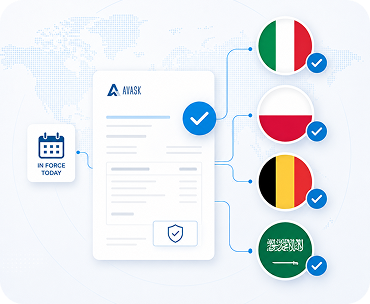
In force today
- Italy operates the longest-established regime in Europe, through its SdI platform.
- Poland (KSeF) and Belgium (structured B2B invoicing) are both now in force.
- Outside Europe, Saudi Arabia has been phasing in its ZATCA regime since 2021.
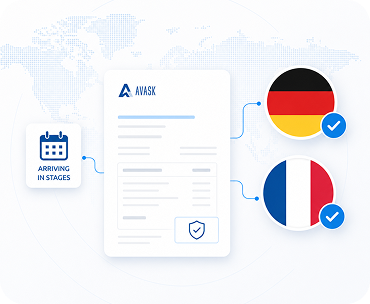
Arriving in stages
- Germany’s receiving obligation is already in force, with issuing requirements following.
- France is introducing its regime in stages, beginning with the ability to receive e-invoices, using Factur-X and accredited platforms.
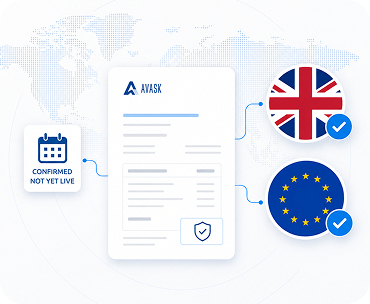
Confirmed, not yet live
- The United Kingdom — all VAT invoices in B2B and B2G transactions must be issued electronically from 1 April 2029, using Peppol.
- The European Union — under ViDA, e-invoicing and digital reporting reach cross-border intra-EU transactions from 1 July 2030, with domestic systems aligning by 1 January 2035.
Does this apply to your business?
Most businesses get this wrong in one of two directions — preparing for a mandate they are not in scope for, or assuming they are exempt from one that will reach them.
Most domestic mandates apply to businesses established in the country concerned. Holding a VAT registration there is not the same thing, and the two are frequently confused.
The right answer depends on where your entities sit, which markets you sell into, what you sell and to whom. It is worth establishing deliberately rather than assuming.
Book an e-invoicing readiness reviewBut establishment is not the whole test. Five things complicate it:
- 01
Receiving obligations are often broader than issuing obligations. You may have to accept a structured invoice long before you have to send one.
- 02
Supplying a public body brings its own rules. B2G requirements frequently apply wherever you are established.
- 03
Cross-border reporting works differently. Under ViDA, digital reporting for intra-EU transactions is not conditional on domestic establishment.
- 04
Group structures change the answer. One entity established in a mandate country is in scope, even if the parent is not.
- 05
Your customers’ obligations become yours. Once a buyer must receive structured invoices, they will ask their suppliers to send them.

E-invoicing is not just an accounting project
It sits where tax, technology, finance and trade meet. Getting the invoice right depends on getting the underlying transaction right.
How AVASK completes the global trade compliance loop
Enter new markets. Move goods. Sell products. Calculate tax. Issue invoices. Report accurately. Grow with confidence
- 1
Enter the market. Registrations, tax rules and regulatory requirements before you begin trading.
- 2
Move goods across borders. Customs registrations, import requirements and international movement.
- 3
Place products on the market. Environmental, packaging and product compliance, including EPR.
- 4
Make the sale. Whether VAT, GST or Sales Tax applies, and the registrations you need.
- 5
Issue the invoice. Preparing for local electronic invoicing formats, submission processes and tax authority systems.
- 6
Report the transaction. Connecting transaction data with returns, reconciliations and ongoing reporting.
- 7
Grow into new markets. A compliance framework that expands with your business.
One platform for global compliance
Managing compliance across spreadsheets, disconnected systems and separate providers makes the full position impossible to see. It also produces duplicated work, inconsistent data and missed deadlines.
The AVASK platform gives you one view of registrations, returns, obligations, deadlines and compliance status across every market — the technology to manage the information, and the specialists to interpret it.
Improve data quality before it costs you
Most businesses don’t find errors before they have been repeated across thousands of invoices and several years of returns. Our platform helps you:
→ Capture purchase and sales invoices in one place
→ Validate VAT and EPR calculations across jurisdictions
→ Hold filing receipts, proof of payment and billing documentation as audit-ready evidence
Connect invoice data with tax reporting
We bring invoice data, tax reporting and reconciliation into one environment — so you can compare invoice data against VAT returns, identify differences, and resolve them before anything reaches a tax authority.
Work with your existing systems
Includes native API connections to Amazon, Shopify and more than 20 other platforms. If you’re using custom technology - we’ll work with your finance and technology teams to connect your existing ERP, accounting, ecommerce and marketplace systems into one flow.
Trusted by e-commerce sellers around the world





Services brought together through AVASK
- Electronic invoicing and digital reporting
- Continuous transaction controls and real time reporting
- Invoice data validation and reconciliation
- Data governance and compliance oversight
- VAT and GST registrations, returns and ongoing compliance
- Sales Tax registrations, reporting and compliance support
- Customs and import compliance
- Extended Producer Responsibility
- Product and regulatory compliance
- International expansion support
- Ongoing compliance monitoring
VAT, GST and Sales Tax
Businesses trading internationally often manage several indirect tax systems at once. VAT and GST obligations arise when goods are imported, stored or sold in another country; in the US, Sales Tax obligations arise from a physical or economic connection with a state.
AVASK helps you manage all three as one international compliance strategy, rather than a set of separate problems.
What ViDA means for businesses in Europe
VAT in the Digital Age — ViDA — is the EU’s programme to modernise VAT reporting and make e-invoicing central to how transaction information reaches tax authorities.
1 Jul 2030
E-invoicing and digital reporting apply to relevant business transactions between Member States.
1 Jan 2035
Domestic digital reporting systems must align with the European framework.
Do not plan around 2030
Member States can introduce domestic requirements ahead of the EU timetable, and several already have.
How we help you prepare
- 1.
Map your entities, registrations, markets and transaction flows.
- 2.
Identify the electronic invoicing and reporting rules that apply.
- 3.
Review invoice data and the underlying VAT, GST or Sales Tax treatment.
- 4.
Assess gaps in systems, data and internal processes.
- 5.
Prioritise markets and implementation deadlines.
- 6.
Coordinate the requirements of tax, finance and technology teams.
- 7.
Test new processes and establish reconciliation controls.
- 8.
Monitor new requirements as your business and the rules change.
Our CaaS Advantage
Why businesses choose AVASK
A complete view of global trade
We connect market entry, customs, product compliance, tax, invoicing and reporting — rather than solving one and leaving you the rest.
Technology with real expertise behind it
Our platform makes compliance information manageable. Our 420+ specialists across 12 countries and 25 languages provide judgement when the rules get complex.
Built for cross-border commerce
We understand marketplaces and international supply chains, and complete around 500,000 VAT filings a year.
Designed for where you’re going
We plan around your current obligations and the markets you intend to enter next.
Frequently asked questions
What is an electronic invoice?
An electronic invoice is created, sent and received in a structured digital format that allows it to be processed automatically by another system, without manual rekeying.
Is a PDF an electronic invoice?
Not always. A PDF is an electronic document, but it may not contain the structured data required by an e-invoicing system or tax authority. Emailing a PDF invoice is not the same as issuing a compliant e-invoice.
Is e-invoicing mandatory in the UK?
Not yet. E-invoicing is currently voluntary for UK B2B transactions where both parties agree. At Autumn Budget 2025 the government announced that all VAT invoices in B2B and B2G transactions must be issued electronically from 1 April 2029, and on 23 June 2026 confirmed Peppol as the core interoperability network. Public bodies covered by the Public Procurement Act 2023 must already accept compliant e-invoices, and NHS Supply Chain requires suppliers to invoice via Peppol.
How does e-invoicing work?
An e-invoice is created in a structured format another system can read without human intervention, then exchanged through a network rather than sent as an email attachment. Under a four-corner model, your provider passes the invoice to your customer’s provider across an interoperability network such as Peppol. Some countries add a fifth corner, where the invoice is validated, cleared or reported to the tax authority at or near the time of the transaction.
Is electronic invoicing mandatory everywhere?
No. Rules and implementation dates differ between countries. Requirements may also depend on the type of transaction, the size of the business, and whether the customer is another business, a consumer or a government body.
What is ViDA?
ViDA stands for VAT in the Digital Age. It is the European Union’s programme for modernising VAT reporting, electronic invoicing and other parts of the VAT system, arriving in stages from 2030.
What are continuous transaction controls?
Continuous transaction controls are systems through which transaction or invoice information is reported to, or validated by, a tax authority close to the time of the transaction. The exact process differs between countries.
Do we need to wait until 2030 to prepare?
No. Several European countries already have domestic requirements in place or are introducing them, and the UK has confirmed its own timetable for 2029. Review the countries in which you operate and prepare according to the local timetable.
When should my business start preparing?
Well before the relevant deadline. Reviewing systems, correcting data and testing invoice processes takes time, particularly across several countries or entities. Data problems are slow to fix because they usually pre-date the project by years.
Can AVASK help with Sales Tax as well as VAT?
Yes. AVASK supports VAT, GST and Sales Tax compliance as part of its global compliance services.
Can AVASK support our wider international obligations?
Yes. AVASK supports electronic invoicing, tax, customs, environmental compliance, product requirements and international expansion through one global compliance platform.